2025-11-18 森林総合研究所,北海道大学,国立環境研究所,千葉県立中央博物館
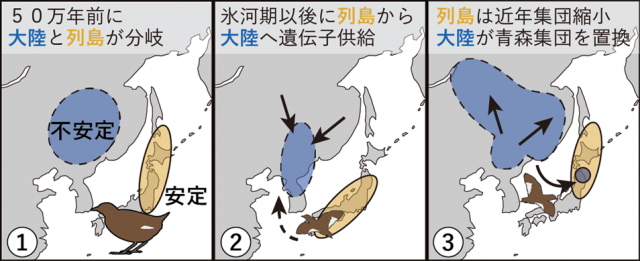
図1:シマクイナが大陸と日本列島で枝分かれしてからの複雑な進化の歴史に関する模式図。楕円は種分布モデルによって予測された繁殖地分布を模式的に示したもの(実線:安定、点線:不安定)を示す。矢印は分布の変化(実線)や遺伝子の供給(点線)を示す。
<関連情報>
- https://www.ffpri.go.jp/press/2025/20251118/index.html
- https://www.ffpri.go.jp/press/2025/20251118/documents/20251118press.pdf
- https://www.ffpri.go.jp/press/2025/20251118/index.html
系統ゲノム解析により、主に大陸に生息する鳥類のメタ個体群動態への島の寄与が支持される Phylogenomics Supports Island Contribution to Metapopulation Dynamics in a Predominantly Continental Bird Species
Daisuke Aoki, Masayuki Senzaki, Haruko Ando, Yoshiya Odaya, Wieland Heim, Munehiro Kitazawa, Tom Wulf, Daronja Trense, Marc Bastardot, Atsunori Fukuda, Masao Takahashi, Natsuko Kondo
Journal of Biogeography Published: 25 August 2025
DOI:https://doi.org/10.1111/jbi.70038
ABSTRACT
Aim
Islands have recently been recognised as potential sources of biodiversity, challenging the traditional view that their small population sizes and low genetic diversity limit such a role. This raises the question of how insular genetic variation becomes incorporated into continental populations, contrary to expectations of unidirectional colonisation. Here, we investigate whether and how island-derived genetic variation has influenced a continental population through population establishment and gene flow in a bird species where frequent trans-ocean dispersal is expected.
Location
Continental East Asia (Russian Far East), Japanese Archipelago.
Taxon
Swinhoe’s rail (Coturnicops exquisitus).
Materials and Methods
We apply integrative phylogenomics to reconstruct the spatiotemporal history of the species. Colonisation sequences and gene flow are inferred by comparing four different phylogenetic reconstruction methods, using mitochondrial sequences obtained by Sanger sequencing and genome-wide data obtained by genotyping by sequencing (MIG-seq). A spatiotemporally explicit history of colonisation and gene flow is reconstructed based on summary statistics, demographic trajectory inference by Stairway Plot2, demographic modelling by fastsimcoal2 and species distribution modelling.
Results
Analyses collectively supported asymmetric gene flow from the island to the continental population, following divergence around the Middle Pleistocene. Post-divergence, the island maintained a large and stable population, while the continental population underwent a severe bottleneck, suggesting a significant evolutionary role of the island for the continental population. Additionally, evidence of recent re-establishment on the island by continental individuals indicates dynamic exchange and persistence within a continent–island metapopulation.
Main Conclusions
The maintenance of insular genetic variation within a dynamic continent-island metapopulation may have enabled the island to act as a genetic and demographic reservoir for the continental population. Thus, continent-island metapopulation dynamics may be a key evolutionary pathway through which island populations contribute to continental genetic diversity.