2025-11-06 中国科学院(CAS)
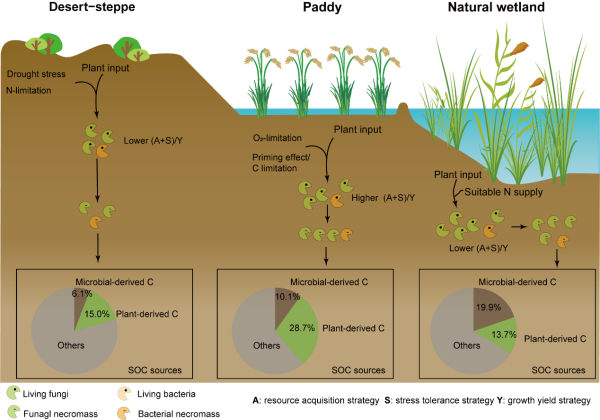
Soil organic carbon accumulation pathways in typical land-use types within a hyper-arid region. (Image by XIEG)
<関連情報>
- https://english.cas.cn/newsroom/research-news/202602/t20260210_1150457.shtml
- https://www.sciencedirect.com/science/article/abs/pii/S0167880925006073
極度乾燥オアシス砂漠移行帯における生態系タイプ間の植物および微生物源からの土壌有機炭素蓄積の相違 Divergent soil organic carbon accrual from plant and microbial sources across ecosystem types in a hyper-arid oasis-desert ecotone
Zhihao Zhang, Guangxing Zhao, Waqar Islam, Corina Graciano, Jingming Yan, Xinpinng Dong, Akash Tariq, Weiqi Wang, Fanjiang Zeng
Agriculture, Ecosystems & Environment Available online: 5 November 2025
DOI:https://doi.org/10.1016/j.agee.2025.110075
Highlights
- Hyper-arid wetlands store more SOC dominated by fungal necromass.
- Paddy SOC is less stable due to plant-derived C dominance.
- Microbial N-limitation alleviation drives SOC accumulation via Y-strategy.
- Soil salinity suppresses microbial necromass accumulation.
- N/P ratio and available N are key drivers of microbial necromass accrual.
Abstract
Soil organic carbon (SOC) dynamics in hyper-arid ecosystems are governed by allocation shifts between plant- and microbial-derived carbon (C). However, the underlying mechanisms governing these dynamics under land-use change remain poorly quantified. To address this, lignin phenols, amino sugar biomarkers, and microbial functional trait analysis were integrated to evaluate how microbial life-history strategies and environmental stressors regulate SOC accumulation across three ecosystem types (natural wetlands, paddies, and desert-steppes) in oasis-desert ecotones of the Taklamakan Desert. Natural wetlands exhibited the highest SOC (4.15 g kg-1) content, with 19.9 % derived from microbial necromass—primarily fungal component—due to alleviated nitrogen limitation [higher nitrogen/phosphorus (N/P) ratio: 0.928] and dominance of microbial growth-yield (Y) strategies. In contrast, paddies (SOC content: 2.57 g kg-1) exhibited the highest plant-derived C contribution (28.7 % of SOC), where plant-derived C was negatively correlated with SOC content, likely driven by C limitation and priming effects under reduced microbial Y-strategist abundance. Desert-steppes (SOC content: 3.44 g kg-1) showed minimal microbial necromass accumulation (6.1 % of SOC) and advanced lignin oxidation (elevated syringyl/vanillyl and cinnamyl/vanillyl), reflecting drought-induced depletion of Y-strategists and incomplete decomposition. Soil salinity was observed to suppress microbial necromass input, while N-P stoichiometry and available N facilitated its accrual. Collectively, our findings indicate a stability dichotomy: wetlands sustain persistent SOC through microbial necromass enrichment, whereas agricultural conversion shifts SOC toward plant-derived C prone to destabilization. Strategies for SOC conservation in hyper-arid oasis-desert ecotones should prioritize the preservation of natural wetlands coupled with implementation of balanced N-P fertilization in anthropogenically managed ecosystems (e.g., paddies). This integrated approach enhances microbial contributions to SOC resilience under ongoing land-use changes.