2025-12-03 カリフォルニア大学サンディエゴ校(UCSD)
<関連情報>
- https://today.ucsd.edu/story/seagrass-study-points-to-promising-pathway-for-ocean-restoration
- https://www.nature.com/articles/s41477-025-02142-2
カリフォルニアアマモ( Zostera spp.)の交雑と低光量適応性 Hybridization and low-light adaptability in California eelgrass (Zostera spp.)
Malia L. Moore,Nicholas Allsing,Nolan T. Hartwick,Allen Mamerto,Emily R. Murray,Rilee D. Sanders & Todd P. Michael
Nature Plants Published:29 October 2025
DOI:https://doi.org/10.1038/s41477-025-02142-2
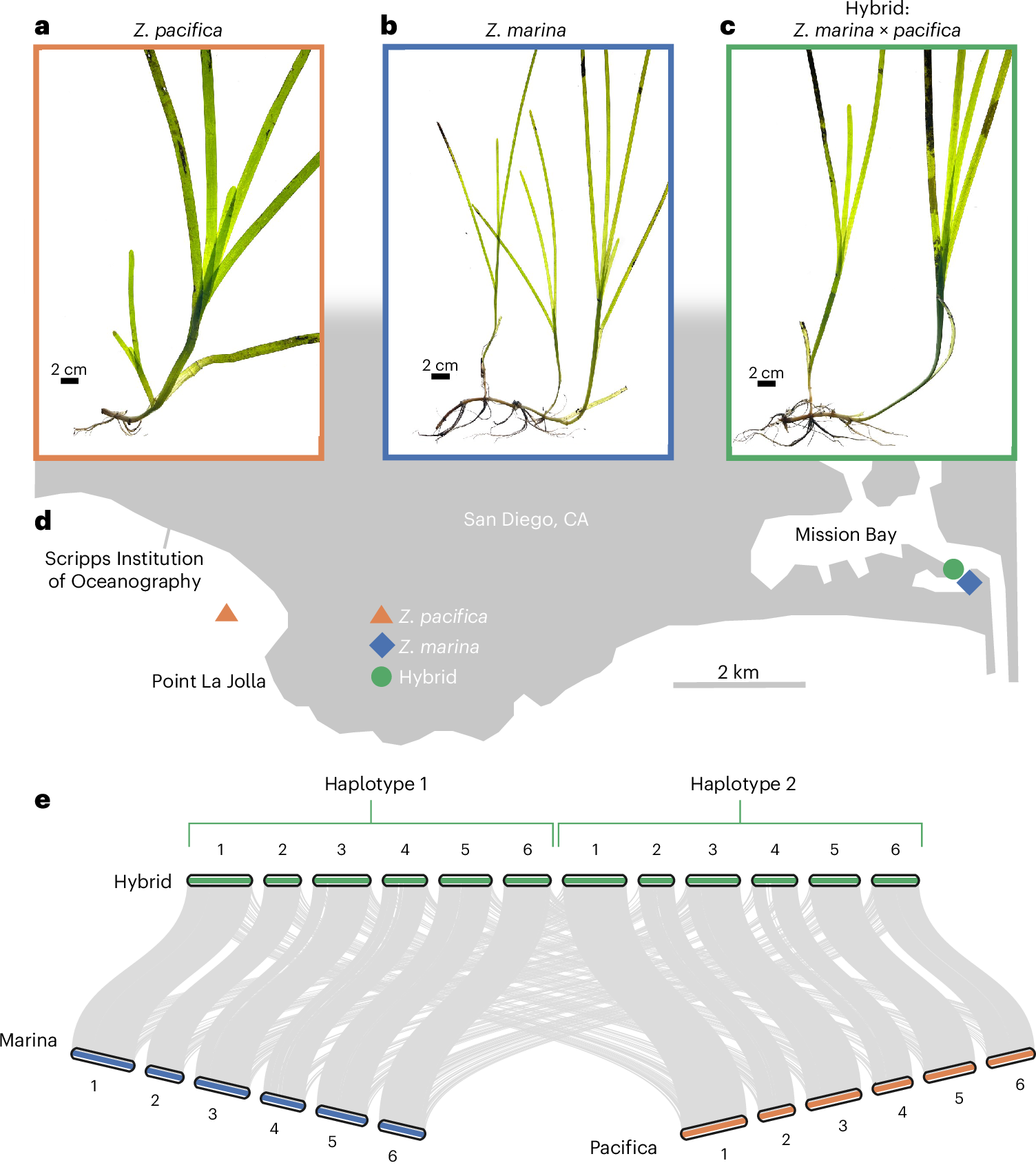
Abstract
The temperate seagrass Zostera marina is a foundational marine species that provides critical habitat in bays and estuaries throughout the Northern Hemisphere. Human activities and climatic events have necessitated Z. marina restoration, for which high transplant mortality rates call for innovative cross-disciplinary solutions. We identify a hybrid between Z. marina and Z. pacifica and explore the hybrid population as a tool for restoration from a genomic perspective. Among several habitat distinctions, Z. pacifica, an endemic to the Southern California Bight (West Coast, USA), is deeper-living and may encode resilience to low light, a leading factor of seagrass restoration failure. We construct a haplotype-resolved chromosome-scale genome assembly of the hybrid and several California Zostera accessions to describe the divergence between Z. marina and Z. pacifica and characterize the hybrid’s stage of maturity as an F1. Transcriptomes of Z. marina and the hybrid subjected to reduced light in an experimental mesocosm reveal divergent trends in photosynthesis, carbohydrate utilization and stress responses. Photoperiod regulation by Z. pacifica orthologues of key circadian clock genes, prominently LATE ELONGATED HYPOCOTYL and WITH NO-LYSINE KINASEs, may drive this response. By describing the hybridization event using genomic and transcriptomic methods, this study presents preliminary evidence of low-light tolerance modulated by a labile circadian clock to motivate further ecological and functional studies of this hybrid as an experimental tool to access Z. pacifica genetics and its relevance to restoration.