
2025-12-18 国立遺伝学研究所
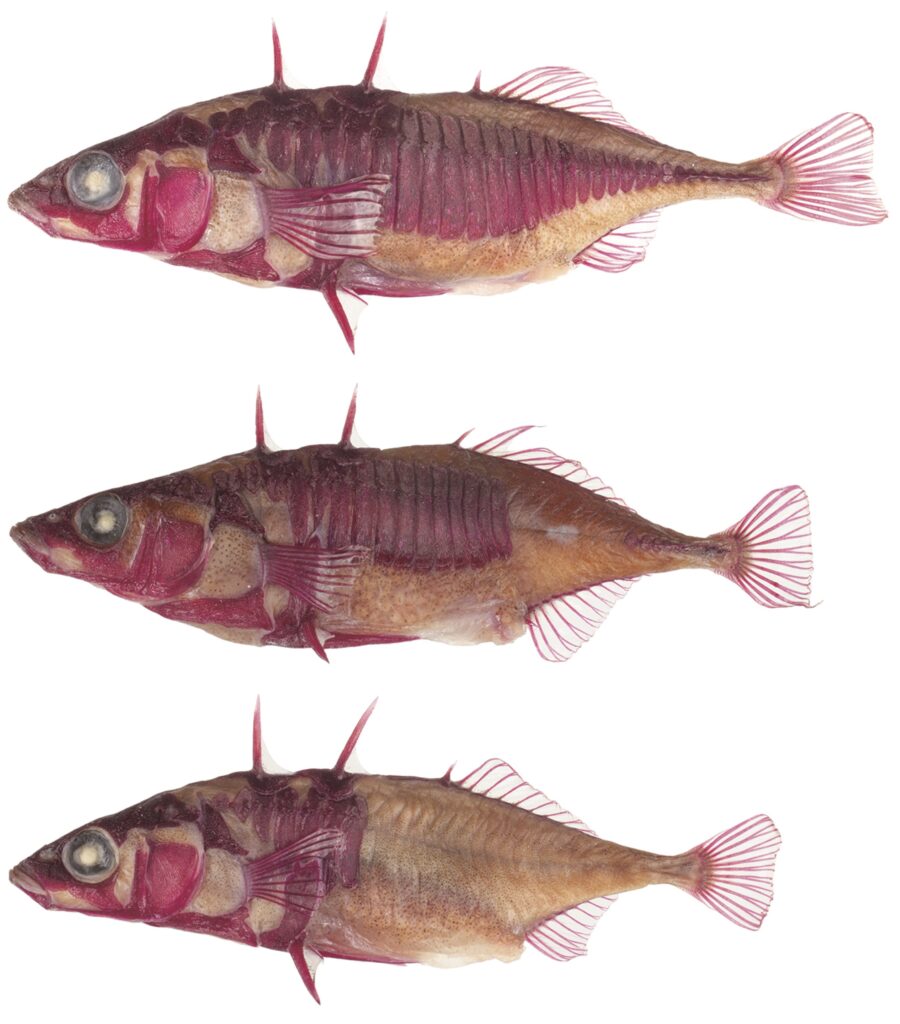
図:ワシントン湖では、鱗板(骨化した外組織)が体の側面の全体をカバーする「完全型」と呼ばれる個体(上)の出現頻度が上昇している。
<関連情報>
- https://www.nig.ac.jp/highlights/4457/
- https://academic.oup.com/evolut/advance-article/doi/10.1093/evolut/qpaf254/8381222
ワシントン湖のイトヨにおける回遊と漂流を考慮した方向選択の強さの推定 Inferring the strength of directional selection on armor plates in Lake Washington stickleback while accounting for migration and drift
Yo Y Yamasaki,Ryo Yamaguchi,Atsushi J Nagano,Bo-Jyun Chen,Naomi Musto,Sophie Archambeault,Catherine L Peichel,Jennifer A Schulien,Tessa J Code,David A Beauchamp,…
Evolution Published:16 December 2025
DOI:https://doi.org/10.1093/evolut/qpaf254
Abstract
Contemporary evolution allows us to investigate how natural selection drives phenotypic and genotypic evolution in nature. Recent advances in molecular genetics have identified causative genes underlying adaptive traits, enabling estimation of selection coefficients at these loci. However, estimating selection is challenging when populations receive migrants from genetically and phenotypically distinct populations. With genome-wide data now allowing estimation of migration rates and effective population sizes, these demographic parameters can be integrated into models for measuring selection. In Lake Washington, USA, the frequency of the completely plated morph of the threespine stickleback (Gasterosteus aculeatus) increased from 1957 to 2005, plausibly due to increased trout predation pressure caused by enhanced water clarity. Here, we estimated the selection coefficient at a major locus responsible for the plate morph using historical data, taking migration and genetic drift into consideration. Model-based predictions of present allele frequencies were tested with samples collected in 2022. Consistent with directional selection, the completely plated morphs and the underlying allele have increased since 2005, but to higher frequencies than predicted, suggesting a recent increase in selection. Thus, integrating molecular genetics, population genomics, and simulations enables the estimation of selection strength while considering migration and drift, to reveal directional selection in nature.
