2025-12-25 京都大学
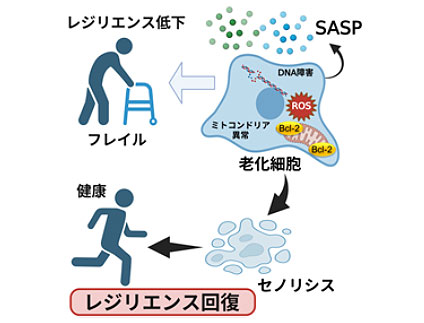
老化細胞由来の慢性炎症により、レジリエンス低下が引き起こされる。レジリエンスの回復には、老化細胞除去(セノリシス)が有効である。
<関連情報>
- https://www.kyoto-u.ac.jp/ja/research-news/2025-12-25-1
- https://www.kyoto-u.ac.jp/sites/default/files/2025-12/Web_2512_Kondoh-83af01ef1705cd3581ea4525b0bbc8e4.pdf
- https://www.nature.com/articles/s41392-025-02502-6
異常な解糖系相互作用の排除は老化細胞を除去し、老化に関連する機能障害を軽減する Abrogation of aberrant glycolytic interactions eliminates senescent cells and alleviates aging-related dysfunctions
Takumi Mikawa,Masahiro Kameda,Sumiko Ikari,Eri Shibata,Shuyu Liu,Sawa Miyagawa,Koh Ono,Tomiko Ito,Akihiko Yoshizawa,Masataka Sugimoto,Shuichi Shibuya,Takahiko Shimizu,Julio Almunia,Noboru Ogiso,Gwladys Revêchon,Alberta Palazzo,David Bernard,Hiroaki Kanda,Tomoyoshi Soga,Keiyo Takubo,Shin Morioka,Junko Sasaki,Takehiko Sasaki,Akihiro Itamoto,… Hiroshi Kondoh
Signal Transduction and Targeted Therapy Published:15 December 2025
DOI:https://doi.org/10.1038/s41392-025-02502-6
Abstract
Cellular senescence is deeply involved in physiological homeostasis, development, tissue repair, aging, and diseases. Senescent cells (SnCs) accumulate in aged tissues and exert deleterious effects by secreting proinflammatory molecules that contribute to chronic inflammation and aging-related diseases. We revealed that an aberrant interaction between glycolytic PGAM1 and Chk1 kinase is augmented in SnCs associated with increased glycolysis, whose byproduct, lactate, promotes this binding in a noncell autonomous manner. The pseudo-Warburg effect of SnCs with enhanced PPP (pentose phosphate pathway) activity is maintained by HIF-2α phosphorylation by Chk1 and subsequent upregulation of glycolytic enzymes, creating a vicious cycle reprogramming the glycolytic pathway in SnCs. HIF-2α also activates FoxM1 expression, which transcriptionally suppresses proapoptotic profiles, including BIM, and upregulates DNA repair machineries in SnCs. FoxM1 thus supports the genomic integrity and survival capacity of SnCs during their glycolytic changes. Chemical abrogation of PGAM1-Chk1 binding reverts these phenotypes and eliminates SnCs through senolysis. Inhibition of the PGAM1-Chk1 interaction improves physiological parameters during aging and inhibits lung fibrosis in mouse models. Our study highlights a novel pathway contributing to the metabolic reprogramming of SnCs and how the use of a new senolytic molecule that targets the PGAM-Chk1 interaction creates a specific vulnerability of those cells to potentially fight age-related diseases.