2026-01-09 京都大学
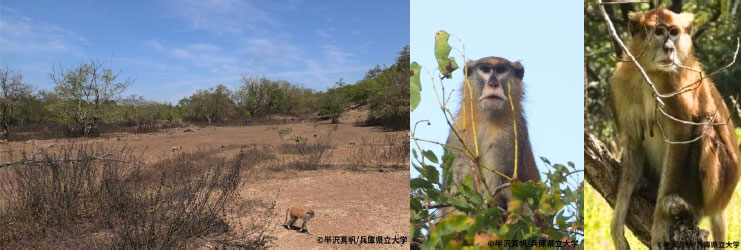
左:食物を探しながら広がって移動するパタスモンキーの群れの様子、中央・右:木に登って見回し行動をするオトナオス(中央)とオトナメス(右)の様子
<関連情報>
- https://www.kyoto-u.ac.jp/ja/research-news/2026-01-09-2
- https://www.kyoto-u.ac.jp/sites/default/files/2026-01/web_2501_Hanzawa-530b64d4c8a8f0eb45ca451ff64475d6.pdf
- https://link.springer.com/article/10.1007/s00265-025-03684-3
視覚と聴覚の手がかりに基づく個々の行動は、パタスモンキー ( Erythrocebus patas ) の集団運動における時空間的調整をどのように促進するのでしょうか? How do individual behaviors based on visual and auditory cues facilitate spatiotemporal coordination in collective movement of patas monkeys (Erythrocebus patas)?
Maho Hanzawa,Yoshiki Morimitsu,Erasmus H. Owusu,Richard D. Suu-Ire & Naofumi Nakagawa
Behavioral Ecology and Sociobiology Published:08 January 2026
DOI:https://doi.org/10.1007/s00265-025-03684-3
Abstract
Collective movement requires individuals to coordinate their behaviors across time and space. Recent advances in GPS tracking have enabled the recording of whole-group movements and estimation of group cohesion. However, integrating individual behavior with group-level dynamics remains a developing approach. In this study, we combined GPS tracking and behavioral observations to examine visual monitoring and calling related to collective movement in a one-male, multi-female group of wild patas monkeys (Erythrocebus patas), with a focus on sex-specific patterns. Females engaged in visual monitoring when fewer juveniles were nearby, which subsequently lead to having increased proximity of juveniles. This suggests that female visual monitoring play a role in maintaining spatial cohesion with juveniles. In contrast, the single adult male engaged in visual monitoring when the travel speed difference between him and females was large, which subsequently lead to having increased travel speed differences. This implies that the male may be engaging in monitoring primarily as vigilance against predators or conspecific groups, possibly to protect females rather than maintain temporal synchrony with them. Interestingly, female contact calls were associated with increased travel speed of others, particularly under conditions where the caller and others were previously moving at similar speeds. This suggests that calls may serve to accelerate group movement through intentional communication. Overall, our findings suggest that visual monitoring and calling function in context-dependent ways, highlighting the value of integrating movement dynamics, intentional communication and behavioral context to understand the mechanisms of collective coordination in group-living animals.