2026-01-19 スウォンジー大学
<関連情報>
- https://www.swansea.ac.uk/press-office/news-events/news/2026/01/could-dietary-change-support-adolescent-mental-health-new-review-highlights-evidence-gaps-and-future-research-priorities.php
- https://www.mdpi.com/2072-6643/17/23/3677
レジリエンスのレシピ:食事と青少年のメンタルヘルスに関する体系的レビュー A Recipe for Resilience: A Systematic Review of Diet and Adolescent Mental Health
Jade E. Tucker,Anthony M. Brennan,David Benton and Hayley A. Young
Nutrients Published: 24 November 2025
DOI:https://doi.org/10.3390/nu17233677
Highlights
What are the main findings?
- Whole-diet patterns and quality indices showed associations with favourable mental health outcomes, whereas single-nutrient supplements yielded less reliable results.
- Associations between diet and mental health were often sensitive to adjustment for socioeconomic status or differed by sex, indicating complex demographic interactions.
What are the implications of the main findings?
- The findings suggest that public health and clinical strategies should prioritise whole-diet approaches over isolated supplementation for promoting adolescent mental health.
- The review establishes a “Roadmap for Future Research” that advocates for dimensional, symptom-based assessment and biomarker-informed trial designs to overcome current methodological limitations.
Abstract
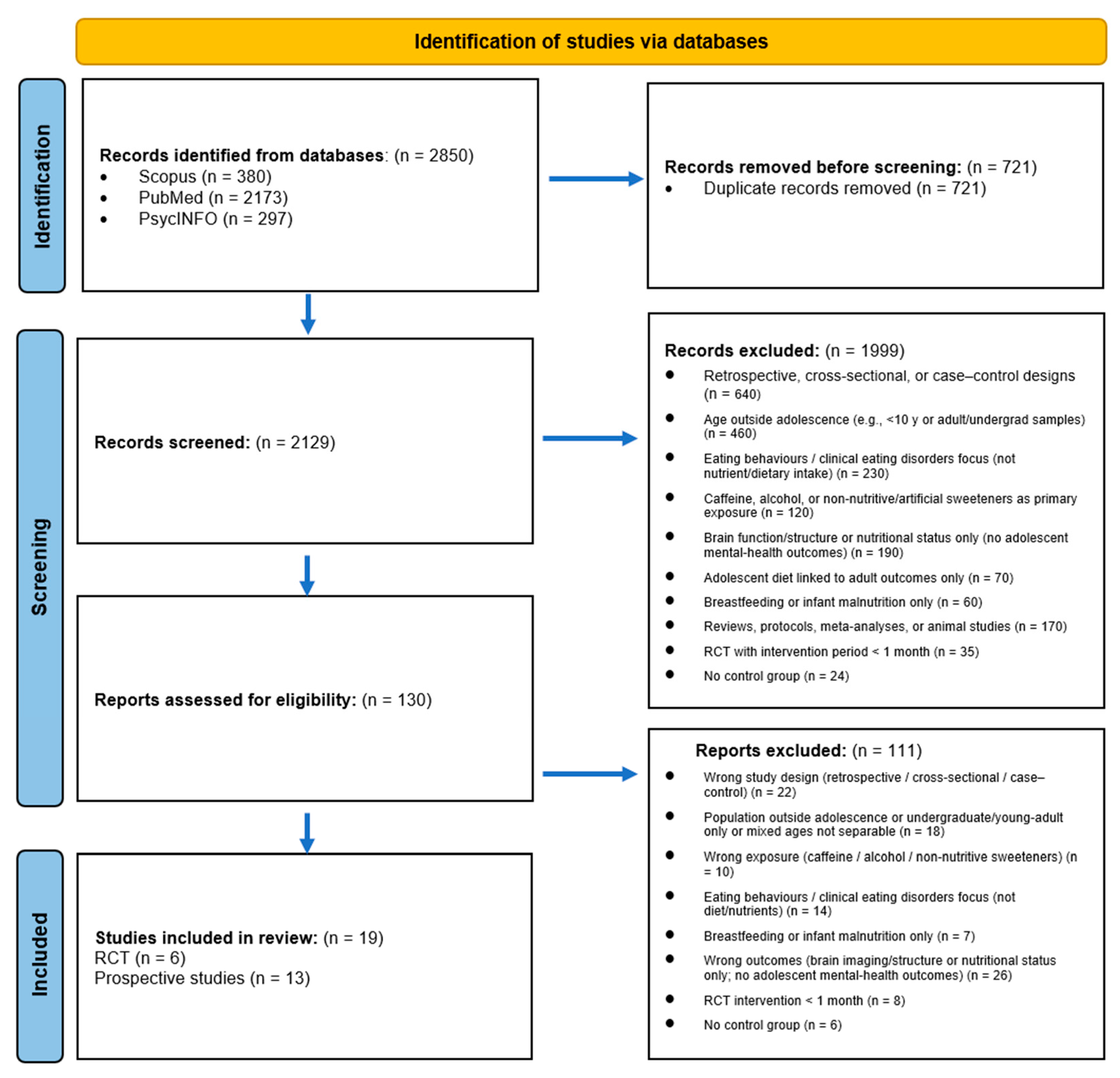
Background/Objectives: Adolescence is a critical period of vulnerability for the onset of mental health difficulties, presenting an urgent need for scalable prevention strategies. Diet is a universal, modifiable factor, yet its evidence base remains inconsistent. This systematic review synthesised evidence from controlled trials and prospective cohort studies investigating the relationship between diet and mental health in adolescents aged 10–19 years.
Methods: Searches were conducted to 20 July 2025, and risk of bias was assessed.
Results: Nineteen studies met the inclusion criteria: six intervention trials and thirteen cohort studies. Examined exposures included vitamin D, omega-3s, polyphenol-rich foods, Mediterranean-style diets, and overall diet quality. Depressive symptoms were the most studied outcome, though the synthesis also included other dimensional outcomes such as anxiety, stress, well-being, and internalising/externalising indices. Across designs, healthier dietary patterns were often associated with fewer depressive symptoms, while poorer diet quality was linked to increased psychological distress. However, the current evidence is constrained by wide variation in assessments, small samples, and significant methodological limitations—particularly with high risk or some concerns noted in half of the included intervention trials—along with evidence suggesting that associations may differ by sex and are often sensitive to adjustment for socioeconomic status. Conclusions: Despite these challenges, the findings suggest diet as a possible, actionable target for supporting adolescent mental health. This review concludes by proposing a detailed roadmap for future research, prioritising harmonised symptom-based outcomes, biomarker-verified assessments, explicit analysis of sex and socioeconomic (SES) effects, and adequately powered trials to inform effective public health strategies for youth. Protocols were registered with PROSPERO (CRD42023413970) and archived on the Open Science Framework.