
2026-01-21 オックスフォード大学
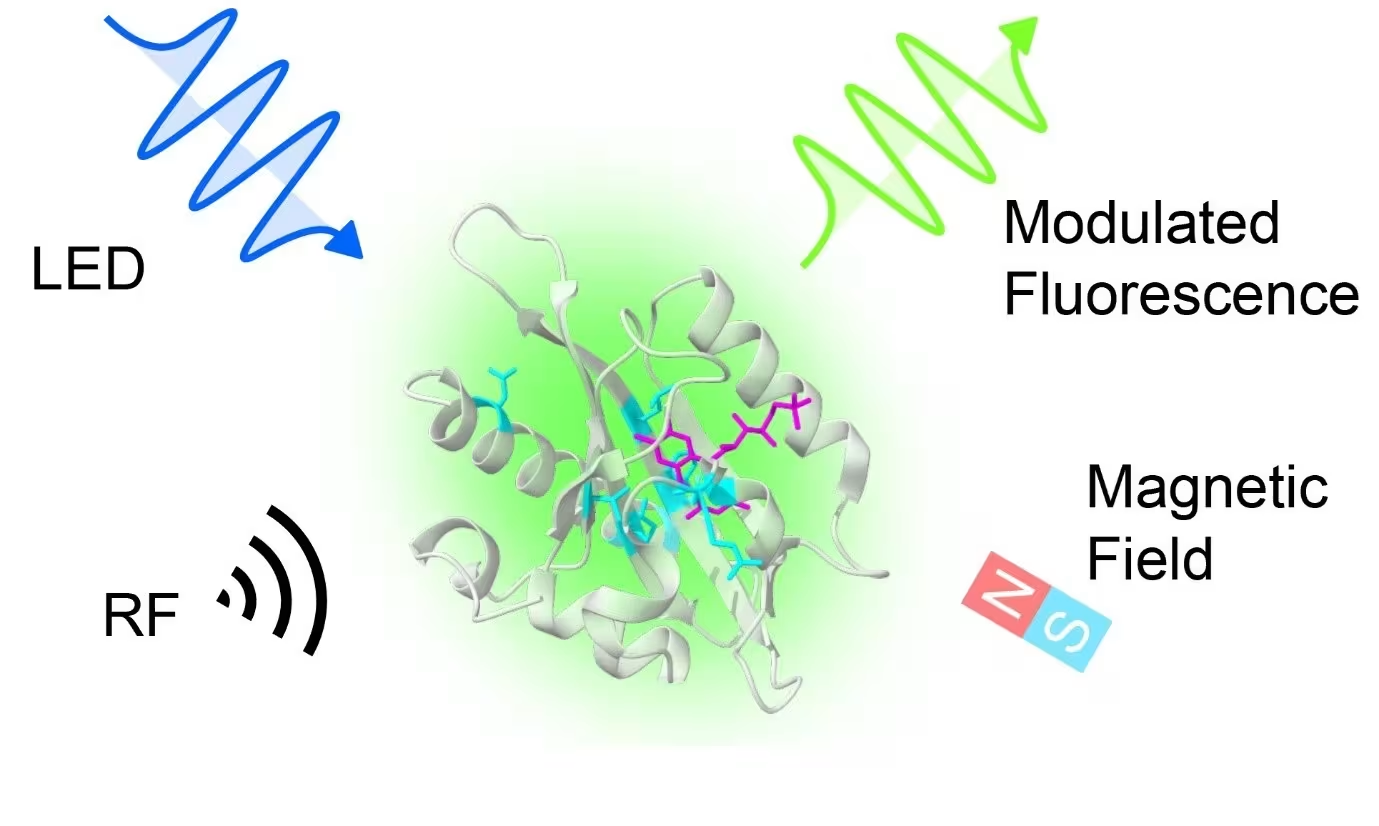
Magneto-sensitive Fluorescent Proteins (MFP) can be excited by light, here delivered by a blue LED. They emit a fluorescent light of a different colour (green). The intensity of this fluorescence can be modulated by applying magnetic or radio frequency (RF) fields of appropriate strengths and frequency. Credit: Gabriel Abrahams.
<関連情報>
- https://www.ox.ac.uk/news/2026-01-21-oxford-team-engineer-quantum-enabled-proteins-opening-new-frontier-biotechnology
- https://www.nature.com/articles/s41586-025-09971-3
マルチモーダルセンシングのための人工タンパク質における量子スピン共鳴 Quantum spin resonance in engineered proteins for multimodal sensing
Gabriel Abrahams,Ana Štuhec,Vincent Spreng,Robin Henry,Idris Kempf,Jessica James,Kirill Sechkar,Scott Stacey,Vicente Trelles-Fernandez,Lewis M. Antill,Christiane R. Timmel,Jack J. Miller,Maria Ingaramo,Andrew G. York,Jean-Philippe Tetienne & Harrison Steel
Nature Published:21 January 2026
DOI:https://doi.org/10.1038/s41586-025-09971-3
Abstract
Sensing technologies that exploit quantum phenomena for measurement are finding increasing applications across materials, physical and biological sciences1,2,3,4,5,6,7. Until recently, biological candidates for quantum sensors were limited to in vitro systems, had poor sensitivity and were prone to light-induced degradation. These limitations impeded practical biotechnological applications, and high-throughput study that would facilitate their engineering and optimization. We recently developed a class of magneto-sensitive fluorescent proteins including MagLOV, which overcomes many of these challenges8. Here we show that through directed evolution, it is possible to engineer these proteins to alter the properties of their response to magnetic fields and radio frequencies. We find that MagLOV exhibits optically detected magnetic resonance in living bacterial cells at room temperature, at sufficiently high signal-to-noise for single-cell detection. These effects are explained through the radical-pair mechanism, which involves the protein backbone and a bound flavin cofactor. Using optically detected magnetic resonance and fluorescence magnetic-field effects, we explore a range of applications, including spatial localization of fluorescence signals using gradient fields (that is, magnetic resonance imaging using a genetically encoded probe), sensing of the molecular microenvironment, multiplexing of bio-imaging and lock-in detection, mitigating typical biological imaging challenges such as light scattering and autofluorescence. Taken together, our results represent a suite of sensing modalities for engineered biological systems, based on and designed around understanding the quantum-mechanical properties of magneto-sensitive fluorescent proteins.

