
2026-01-26 ノースウェスタン大学
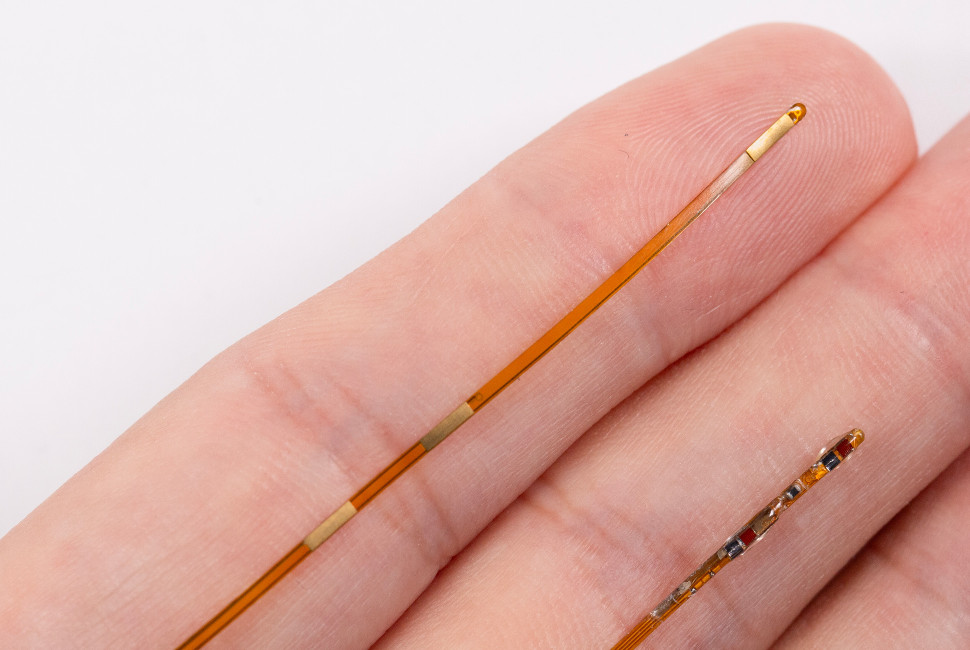
Just three times the width of a diameter of a single hair, the robotic probe enters through a surgerical port to track heart rate, blood oxygen level and temperature. Credit: John A. Rogers/Northwestern University
<関連情報>
- https://news.northwestern.edu/stories/2026/01/first-of-its-kind-probe-monitors-fetal-health-in-utero-during-surgery
- https://www.nature.com/articles/s41551-025-01605-3
胎児の健康状態を子宮内でマルチモーダルモニタリングするためのフィラメント状ソフトロボットプローブ A filamentary soft robotic probe for multimodal in utero monitoring of fetal health
Hedan Bai,Jianlin Zhou,Mingzheng Wu,Steven Papastefan,Xiuyuan Li,Haohui Zhang,Kaiyu Zhao,Zhuoran Zhang,Wei Ouyang,Catherine R. Redden,Amir M. Alhajjat,Heyang Wang,Yibo Zhou,Kenneth Madsen,Shuo Li,Andrew I. Efimov,Katelyn Ma,Lisa Kovacs,Sahdev Patel,Daniel R. Liesman,Katherine C. Ott,Rinaldo Garziera,Steffen Sammet,Wenming Zhang,… John A. Rogers
Nature Biomedical Engineering Published:26 January 2026
DOI:https://doi.org/10.1038/s41551-025-01605-3
Abstract
Fetal surgery offers valuable opportunities to address severe congenital disabilities, yet accurate evaluation of fetal physiological changes during in utero procedures to mitigate the risk of operative complications remains an unmet need. Conventional unimodal approaches lack predictive value, specificity and compatibility with minimally invasive interventions. Here we present a bioelectronic system featuring a multimodal, steerable filamentary probe that interfaces directly with the fetus in utero, enabling reliable and minimally invasive monitoring of various physiological parameters. Integrated soft robotic actuators ensure consistent contact through controlled navigation and force delivery, creating a gentle and secure interface with delicate fetal surfaces. In a sheep fetal surgery model, the multifunctional probe effectively monitored in utero conditions during fetoscopic surgeries, detecting fetal bradycardia, hypoxia and hypothermia, potentially informing for early intervention. Experimental results on rodents and large animal fetuses demonstrate potential for direct translation to human use. This system offers continuous, comprehensive fetal monitoring, addressing gaps in current clinical practices, and provides real-time insights during fetal surgeries.

