2026-01-30 琉球大学
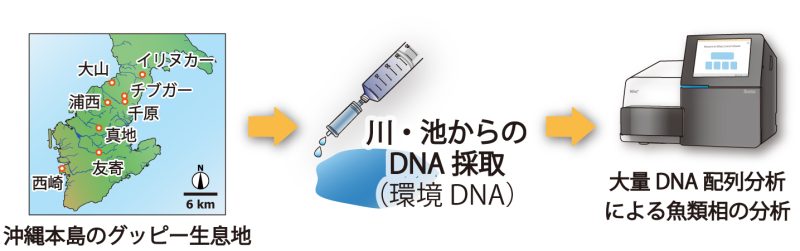
図1.環境DNAに基づく沖縄グッピー生息地の網羅的な魚類相解析
<関連情報>
- https://www.u-ryukyu.ac.jp/news/75159/
- https://www.u-ryukyu.ac.jp/wp-content/uploads/2026/01/ae8273e2f79547e0a7c2b3409ed33e97.pdf
- https://www.nature.com/articles/s41598-025-34186-x
グッピーが導入された河川におけるグッピー雄の色彩パターンと環境DNA分析から推定された捕食者組成 Estimated predator composition using environmental DNA analyses and color patterns of male guppies in introduced rivers
Yukuto Sato,Yuta Sato,Ozora Deki,Kazuki Tsuji & Kaori Tsurui-Sato
Scientific Reports Published:06 January 2026
DOI:https://doi.org/10.1038/s41598-025-34186-x
Abstract
Understanding the mechanisms underlying the successful invasion of the guppy, Poecilia reticulata, a globally invasive species, is important in the field of invasion biology. The body color pattern of male guppies is known to influence predation risk; however, the relationship between body color pattern and local predator guilds has been addressed in only a few studies. To investigate this relationship, we analyzed 32 water samples and 305 male guppies from eight introduced populations on the main island of Okinawa, Japan. The environmental DNA metabarcoding analysis of teleosts from the waters identified six potential guppy predator families, Anguillidae, Eleotridae, Gobiidae, Cichlidae, Mugilidae, and Cyprinidae; however, there was no detection of Characiformes, which are one of the major predators of guppies in their original habitat. Using imaging analysis of color spot areas of male guppies, we found that 16 of 18 potential predator × color combinations exhibited a statistically significant association between body color and the presence of predator families. For example, a negative association between orange spots and Anguillidae, and a positive association between blue-green spots and Cichlidae. These results suggest that the guppy in Okinawa was ecologically released from a major predator in its native habitat and adapted to the new environment through color pattern changes.