2026-01-29 カロリンスカ研究所(KI)
<関連情報>
- https://news.ki.se/pain-in-adolescence-linked-to-increased-risk-of-self-harm
- https://www.sciencedirect.com/science/article/pii/S0165178126000235
疼痛症状と自傷行為における遺伝的要因と環境的要因、そしてそれらの関連性。双子研究 Genetic and environmental factors in pain symptoms and self-harm, and their association. A twin study
Jenny Rickardsson, Mark J. Taylor, Paul Lichtenstein, Henrik Larsson, Sebastian Lundström, Karin Jensen, Maria Lalouni
Psychiatry Research Available online: 19 January 2026
DOI:https://doi.org/10.1016/j.psychres.2026.116962

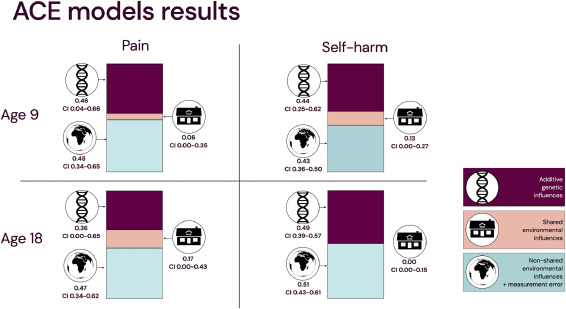
Fig. 1. ACE model estimates for the additive genetic, shared environment and non-shared environmental influence on pain and self-harm, at ages 9 and 18, with point estimates and 95% confidence intervals.
Highlights
- Genetic and non-shared environmental factors contribute to pain symptoms and self-harm to a moderate degree in this large twin study.
- Childhood pain symptoms were associated with increased odds for later self-harm, and the association was only marginally due to genetic factors. The association remained after controlling for depression and anxiety, and familial confounding.
- Pain symptoms in childhood were associated with later self-harm and future research should investigate if this association is causal.
Abstract
Individuals who self-harm are often insensitive to pain, and consequently pain sensitivity has been proposed as a barrier for self-harm. It is unclear how pain and self-harm interplay in real life settings, and to what extent genetics and environmental factors contribute to the etiology of both.
This study was registry based using classical twin design. A cohort of 16 948 Swedish twin pairs born between 1992 and 2010, was prospectively assessed for pain symptoms at ages 9 and 18, and followed up for later self-harm until 2016 and a maximum age of 24.
The relative contributions of genetic and environmental factors to each phenotype were estimated using univariate twin models. Logistic regression models assessed their association, and conditional models adjusted for familial confounding.
Genetics and non-shared environment contributed to pain and self-harm to a moderate degree at both age 9 and age 18, while the contribution of shared environment was small for both pain and self-harm at both ages. At age 18 the pain symptoms group had higher odds for later self-harm (odds ratio 1.59, 95% CI 1.06–2.41, p = .003), and pain seemed to be partially in the causal pathway as it was not explained by familial confounding. This study adds to the evidence of pain symptoms as a predictor for self-harm.