2026-02-03 熊本大学
<関連情報>
- https://www.kumamoto-u.ac.jp/whatsnew/seimei/20260203-1
- https://www.kumamoto-u.ac.jp/daigakujouhou/kouhou/pressrelease/2025_file/release260203-1.pdf
- https://www.jstage.jst.go.jp/article/circrep/advpub/0/advpub_CR-25-0310/_article/-char/en
現役時代から定年退職まで ― 1週間のホルター心電図と加速度計を用いた睡眠時間と心房細動の関係 ― From Working to Retirement-Age ― How Sleep Duration Is Related to Atrial Fibrillation Using 1-Week Holter-Electrocardiogram With Accelerometry ―
Tadashi Hoshiyama , Kenichi Tsujita, Yuko Inoue, Masanobu Ishii, Koichiro Kumagai, Takahisa Noma, Kenzaburo Nakajima, Yoshihiro Kokubo, Masatoshi Koga, Naoki Mochizuki, Hisao Ogawa, Kengo Kusano
Circulation Reports Published:December 24, 2025
DOI:https://doi.org/10.1253/circrep.CR-25-0310
Abstract
Background: Age-specific differences in the association between sleep duration and atrial fibrillation (AF) remain uncertain.
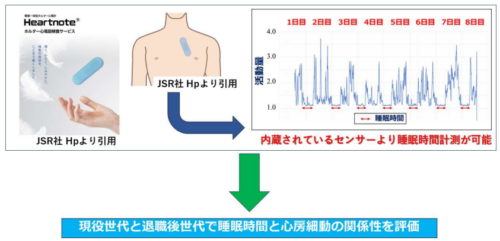
Methods and Results: Using the estimated sleep duration derived from accelerometer data embedded in the Holter-electrocardiogram, association between sleep duration and AF was explored among individuals in their 50 s (working-age) and 70s (retirement-age). In the overall population, AF risk decreased with longer sleep, but the benefit diminished with excessively long sleep (P=0.03). Also, consistent risk reduction with increasing sleep was observed in the 50s age group (P=0.02), but not in the 70s.
Conclusions: Inadequate sleep may be associated with AF, particularly, among middle-aged individuals.