2026-02-03 トロント大学(U of T)
<関連情報>
- https://www.utoronto.ca/news/life-expectancy-study-reveals-dangers-model-minority-stereotype
- https://academic.oup.com/psychsocgerontology/article/81/2/gbaf248/8419857
アジア系アメリカ人の死亡率の傾向における異質性、2000~2022年 Heterogeneity in Asian Americans’ mortality trends, 2000–2022
Hui Zheng, PhD;Yoonyoung Choi, PhD;Leafia Ye, PhD;Ming Wen, PhD
The Journals of Gerontology: Series B Published:12 January 2026
DOI:https://doi.org/10.1093/geronb/gbaf248
Abstract
Objectives
Although Asian Americans are the fastest-growing racial/ethnic group in the United States, their recent mortality trends have not been sufficiently studied. This study provides a comprehensive analysis of years of life lost (YLL) from age 25 to 84 among six largest Asian ethnic groups, comparing them to non-Hispanic Whites.
Methods
We analyzed data from the CDC Multiple Cause of Death database and the American Community Survey (2000–2022) using a cause of death decomposition method.
Results
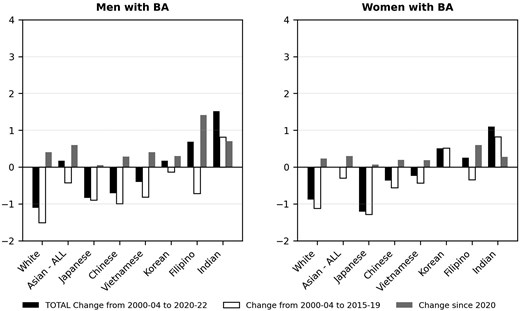
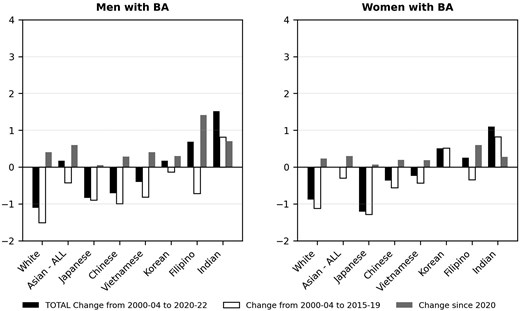
Among college-educated individuals, all Asian ethnic groups experienced either a smaller decrease or an increase in YLL compared to Whites in 2000–2022. These disparities were not primarily driven by the COVID-19 pandemic, though Filipinos and Indians were disproportionately affected compared to Whites. Instead, the divergence in YLL trends predates 2020. Indians showed the most unfavorable trend, with YLL worsening even before the pandemic, followed by Koreans. At least 75% of the smaller YLL reductions among Asians were due to slower improvements in mortality from circulatory diseases, cancer, and diabetes. These findings indicate a less favorable mortality trend for Asian Americans compared to White Americans, particularly the college-educated, in the early 21st century. They also suggest that, over time, Asians may be deriving diminishing health returns from higher education compared to Whites.
Discussion
We discuss differential trends between Whites and Asians, as well as variation within Asian ethnic and educational groups, in the context of socioeconomic conditions, labor market dynamics, racialization in the United States, and stages of nutrition transition in countries of origin.