2026-06-04 ニューヨーク大学(NYU)
 A spotted lanternfly in Shanghai. In the insect’s native China, some lanternflies have partially blue wings, unlike the grey seen on those that have invaded the US. Photo credit: Fallon Meng/NYU
<関連情報>
- https://www.nyu.edu/about/news-publications/news/2026/february/cities-spotted-lanternflies-study.html
- https://royalsocietypublishing.org/rspb/article/293/2064/20252292/480066/Cities-as-evolutionary-incubators-for-the-global
都市は、琵琶羽衣(ビワハゴロモ)の世界的な蔓延の進化的インキュベーターである Cities as evolutionary incubators for the global spread of the spotted lanternfly
Fang Meng;Anthony A. Snead;Aria Yang Zhang;Jason Munshi-South;Kristin M. Winchell
Proceedings of the Royal Society B: Biological Sciences Published:04 Feb 2026
DOI:https://doi.org/10.1098/rspb.2025.2292
Abstract
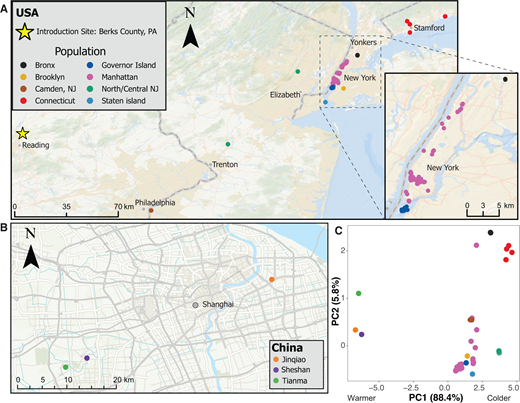
Habitat destruction and invasive species pose two of the greatest global threats to biodiversity. These factors do not operate in isolation, and nowhere is their interaction more apparent than in urban environments. Urban organisms rapidly evolve under novel ecological circumstances where they also encounter anthropogenic opportunities for range expansion. We examine the role of urbanization in the invasive success of the spotted lanternfly, an emerging global pest, during its colonization and expansion. We demonstrate that the invasive population in the United States has undergone three sequential bottlenecks, resulting in significantly reduced genetic diversity and elevated inbreeding. The success of this invasive population may be partly attributable to adaptation in the native range before the invasion. We detect divergence between urban and rural lanternflies in Shanghai, China (the invasion origin), in genes related to stress response, metabolism and detoxification pathways. Additionally, we detect genomic signatures of selection in the invasive population, suggesting adaptive refinement as the invasion progresses. This study provides evidence of adaptive evolution in response to urbanization despite substantial loss of genetic diversity and implicates adaptive responses to pesticide application, dietary shifts, and climate in the invasive success of the spotted lanternfly.