2026-02-12 成育医療研究センター
<関連情報>
- https://www.ncchd.go.jp/press/2026/0212.html
- https://pubmed.ncbi.nlm.nih.gov/41640356/
- https://onlinelibrary.wiley.com/doi/epdf/10.1111/all.70245
洗濯用洗剤は同時に吸入した抗原の感作を促進し、気道炎症を増悪させる Laundry Detergents Enhance Sensitization to Co-Inhaled Allergens and Exacerbate Airway Inflammation in Mice
Naoko Nagano, Masato Tamari, Hiromichi Yamamoto, Hisataka Nakazaki, Satoshi Fujita, Yuka Hayashi, Kenichiro Motomura, Sanne Johanna Maria de Bruijn, Ken Arae, Terufumi Kubo, Masashi Ikutani, Katsuko Sudo, Hidenori Kage, Hirohisa Saito, Susumu Nakae, Kenji Matsumoto, Cezmi A. Akdis, Hideaki Morita
Allergy Published: 05 February 2026
DOI:https://doi.org/10.1111/all.70245
Abstract
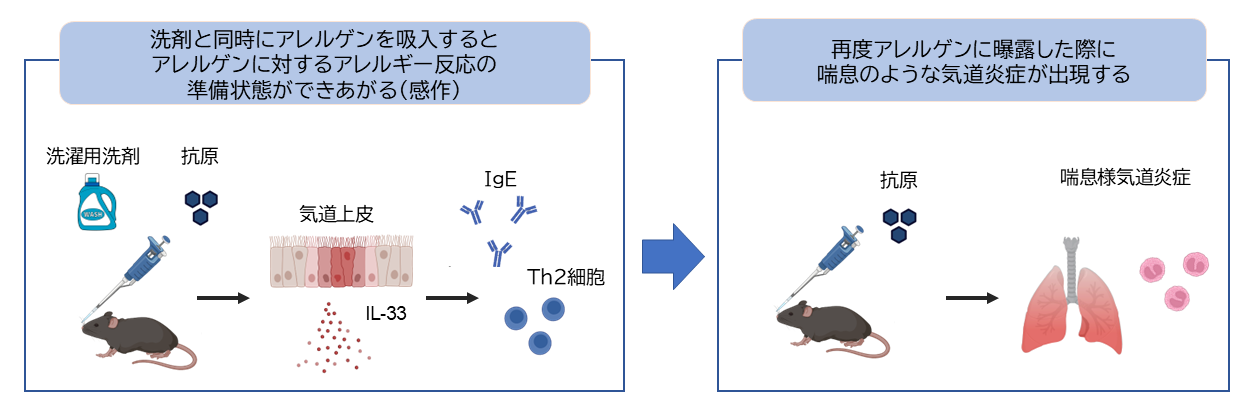
Background: Our previous study demonstrated that laundry detergents induce group 2 innate lymphoid cell-driven eosinophilic airway inflammation by disrupting airway epithelial barriers and promoting IL-33 release, and that detergent residues are present in nearly all household dust. However, their impact on allergen-induced airway inflammation remains unclear.
Methods: C57BL/6 background mice were intranasally primed four times with ovalbumin (OVA) or house dust mite (HDM) allergens in the presence or absence of a commercial laundry detergent. Following priming, mice were challenged with the same antigen for 3 consecutive days and sacrificed the day after the final challenge. Bronchoalveolar lavage fluid (BALF) and sera were analyzed by ELISA. Lungs were evaluated histologically and analyzed by qPCR.
Results: Mice intranasally primed with antigen in the presence of detergent exhibited eosinophilic airway inflammation upon antigen challenge, accompanied by increased IL-5 and IL-13 levels in the BALF. Intranasal administration of detergent and antigen also stimulated antigen-specific IgE production. These detergent- and allergen-induced type 2 responses were significantly suppressed in Il33-/- and Il13-/- mice. Administration of an anti-IL-4 receptor α chain antibody during the challenge phase reduced eosinophil counts in the BALF and antigen-specific IgE levels in the serum. By contrast, anti-IL-33 antibody treatment during the challenge phase did not affect eosinophilic airway inflammation or antigen-specific IgE production.
Conclusions: Laundry detergents promote sensitization to co-inhaled allergens and exacerbate eosinophilic airway inflammation and antigen-specific IgE responses via IL-33 and IL-13. These findings suggest that detergents can act as adjuvants that facilitate airway sensitization.
Keywords: adjuvant effect; biologics; bronchial asthma; epithelial barrier theory; laundry detergent.