2026-02-16 東京大学
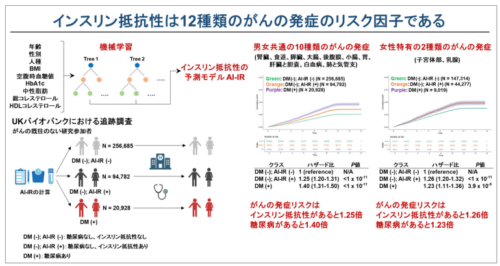
本研究の概念図(論文より引用改変)
<関連情報>
- https://www.h.u-tokyo.ac.jp/press/20260216.html
- https://www.h.u-tokyo.ac.jp/press/__icsFiles/afieldfile/2026/02/16/release_20260216.pdf
- https://www.nature.com/articles/s41467-026-68355-x
機械学習で予測されたインスリン抵抗性は12種類の癌の危険因子である Machine learning-predicted insulin resistance is a risk factor for 12 types of cancer
Chia-Lin Lee,Tomohide Yamada,Wei-Ju Liu,Kazuo Hara,Toshimasa Yamauchi,Shintaro Yanagimoto & Yuta Hiraike
Nature Communications Published:16 February 2026
DOI:https://doi.org/10.1038/s41467-026-68355-x
Abstract
Insulin resistance is suggested to be a risk factor for cancer; however, large-scale epidemiological evidence linking insulin resistance to cancer remains limited. Here we apply a machine learning-based prediction model of insulin resistance with nine clinical parameters, termed artificial intelligence–derived insulin resistance (AI-IR), to the UK Biobank and demonstrated that AI-IR exhibits the highest predictive performance for diabetes incidence compared to body mass index (BMI), metabolic syndrome (MetS), triglyceride to high-density lipoprotein cholesterol (TG/HDL) ratio, and triglyceride-glucose (TyG) index. Moreover, AI-IR is significantly associated with an increased risk of six cancers (uterine, kidney, esophagus, pancreas, colon, and breast) and showed nominal associations with six additional cancers (renal pelvis, small intestine, stomach, liver and gallbladder, leukemia, and bronchial and lung). When we define composite cancers by merging cancer types whose risks increase with AI-IR, age- and sex-adjusted hazard ratio is 1.25 (95% confidence interval, 1.20-1.31; P < 1 ×10-11). AI-IR is a better predictor of the composite cancers compared to BMI and TyG index, while its capability is comparable to that of MetS and TG/HDL ratio. We conclude that AI-IR is a robust metric for predicting both diabetes and the composite cancer incidence and could be utilized for identification of high-risk individuals and focused screening.