
2026-02-19 基礎生物学研究所
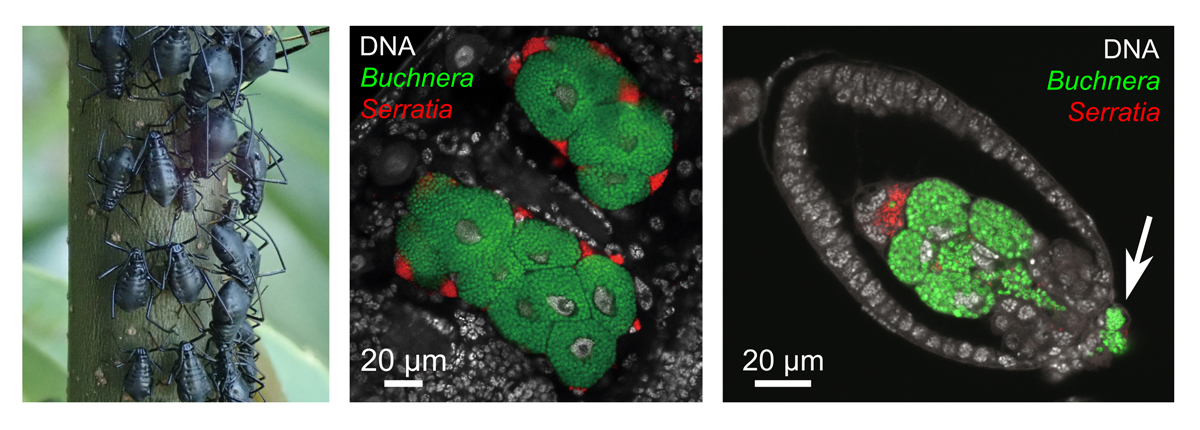
左図:クリオオアブラムシ、中央・右図:FISH法によって可視化された共生細菌(ブフネラとセラチア)のアブラムシ体内での局在(中央)と胚発生時の垂直伝達(右)(矢印は胚への侵入開始点を示す)。
<関連情報>
- https://www.nibb.ac.jp/press/2026/02/19.html
- https://royalsocietypublishing.org/rspb/article/293/2065/20252484/480371/Symbiont-replacement-and-subsequent-genome-erosion
共生細菌の置換とそれに続くゲノム侵食がアブラムシの二重共生関係を再形成する Symbiont replacement and subsequent genome erosion reshape a dual obligate aphid symbiosis
Tomonari Nozaki;Yuuki Kobayashi;Mika Ikeda;Shuji Shigenobu
Proceedings of the Royal Society B Published:18 Feb 2026
DOI:https://doi.org/10.1098/rspb.2025.2484
Abstract
Many insects rely on obligate microbial symbioses, often involving multiple partners. Although symbiont replacement is well-documented, how newly acquired and resident obligate symbionts adapt after such events remains unclear. Here, we investigate the dual obligate symbiosis of the aphid Lachnus tropicalis, where an ancestral Serratia lineage was replaced by a newly acquired Serratia lineage while the primary symbiont Buchnera remained. Our metagenomic sequencing yielded complete genomes of Buchnera (0.42 Mb) and Serratia (2.8 Mb), revealing developing metabolic complementarity. Although the Serratia genome retained abundant gene sets for amino acid synthesis, it also contained pseudogenes in leucine and methionine pathways, which would be compensated for by Buchnera or the host. Comparison with Lachnus roboris, which harbours the ancestral Serratia lineage, showed that the newly acquired Serratia in L. tropicalis exhibits identical tissue localization and vertical transmission pattern, suggesting the smooth succession of the prior microniche. Notably, Buchnera in L. tropicalis exhibited a slightly more degenerated genome than its counterpart in L. roboris, indicating that symbiont replacement can accelerate gene loss even in ancient symbionts. Overall, our findings provide new insights into the dynamics of novel mutualism establishment and highlight symbiont replacement as a driver of host–symbiont co-evolution.

