2026-04-09 北海道大学
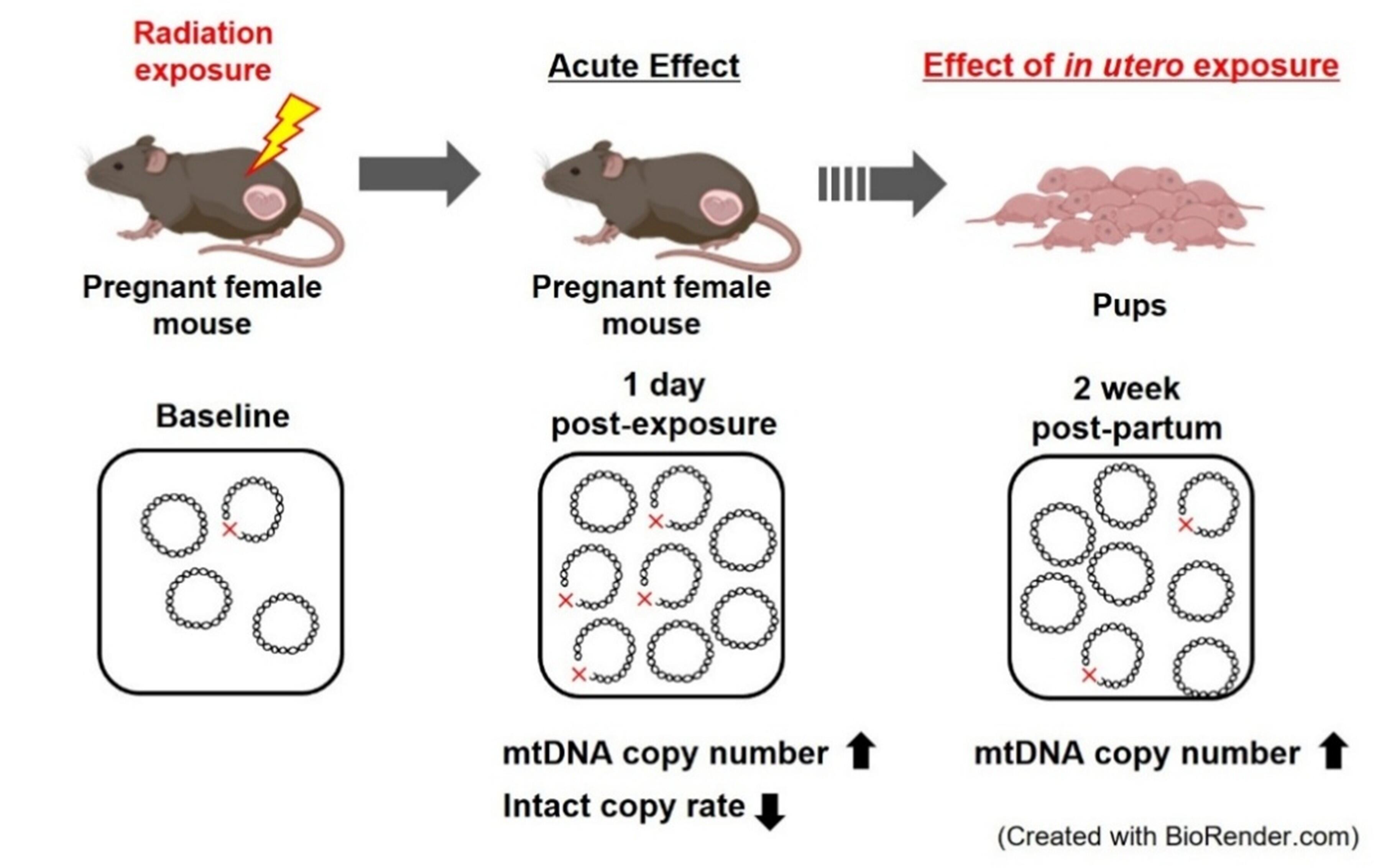
妊娠初期の放射線被ばくは、母体には高線量でmtDNAの量的増加と正常コピー比の低下をもたらす一方、仔にはより低線量からmtDNAコピー数の増加をもたらす。
<関連情報>
- https://www.hokudai.ac.jp/news/2026/04/dna-15.html
- https://www.hokudai.ac.jp/news/pdf/260409_pr.pdf
- https://www.sciencedirect.com/science/article/abs/pii/S089158492600256X
受胎内放射線被ばくによる母体及び次世代のミトコンドリアDNA変化 Mitochondrial DNA alterations in mothers and offspring following in utero exposure to ionizing radiation
Ryosuke Seino, Haruka Kubo, Atsuko Ikeda, Hisanori Fukunaga
Free Radical Biology and Medicine Available online 27 March 2026
DOI:https://doi.org/10.1016/j.freeradbiomed.2026.03.065
Highlights
- In utero X-ray exposure at GD8 yielded live offspring at doses ≤0.5 Gy.
- Maternal mtDNAcn rose at 2 Gy, while the intact mtDNA ratio fell at ≥0.5 Gy.
- Offspring showed elevated mtDNAcn at ≥0.2 Gy without growth changes.
- A consistent inverse relationship was observed between mtDNAcn and integrity.
Abstract
Ionizing radiation can perturb mitochondrial homeostasis and genomic stability, yet its developmental consequences remain insufficiently understood. We investigated how in utero X-ray exposure may affect mitochondrial DNA (mtDNA) regulation and developmental parameters in a mouse model. Pregnant C57BL/6N mice were exposed to 0 (sham-irradiated), 0.05, 0.2, 0.5 and 2 Gy X-rays at gestational day 8, corresponding to the onset of organogenesis. In maternal peripheral blood, mtDNA copy number (mtDNAcn) increased at 2 Gy, while the intact mtDNA ratio, defined as the degree of mtDNA homoplasy estimated by long-fragment PCR, decreased at ≥ 0.5 Gy. Pregnancy resulted in live offspring at GD8 X-ray doses of 0.5 Gy or lower. Offspring sex ratios and body weights did not differ between control and irradiated groups. Notably, offspring examined at two weeks of age exhibited significantly elevated mtDNAcn at ≥ 0.2 Gy, whereas intact mtDNA ratios were unchanged. These results demonstrate that in utero X-ray exposure is associated with dose-dependent alterations in mtDNA regulation in both mothers and their offspring, with distinct sensitivities observed between maternal and offspring responses. These findings highlight mitochondrial responses to radiation exposure during early development and suggest that prenatal irradiation may influence mtDNA regulation, with potential implications for mitochondrial function later in life.