2025-06-17 理化学研究所,東京大学
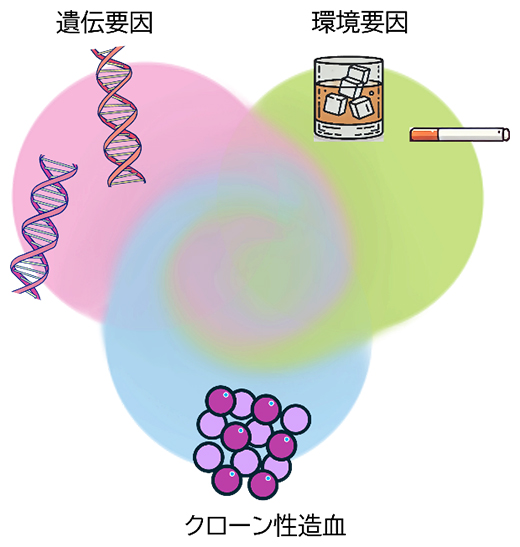
遺伝要因と環境要因の組み合わせで異なるTP53遺伝子変異を伴うクローン性造血の影響
<関連情報>
- https://www.riken.jp/press/2025/20250617_2/index.html
- https://aacrjournals.org/bloodcancerdiscov/article/doi/10.1158/2643-3230.BCD-24-0355/762976/Clinical-Significance-of-TP53-Mutant-Clonal
TP53変異クローン造血の疾患横断的 臨床的意義 Clinical Significance of TP53-Mutant Clonal Hematopoiesis Across Diseases
Yoshiaki Usui;Mikiko Endo;Yusuke Iwasaki;Hanae Iijima;Hidewaki Nakagawa;Koichi Matsuda;Yukihide Momozawa
Blood Cancer Discovery Published:June 17 2025
DOI:https://doi.org/10.1158/2643-3230.BCD-24-0355
Abstract
Clonal hematopoiesis of indeterminate potential (CHIP) has broad clinical relevance, and TP53 plays various roles within cells. However, the gene-specific and cross-disease significance of CHIP with TP53 mutations (TP53-CHIP) remains unclear. In this study, we evaluated TP53-CHIP using targeted sequencing data of 140,597 individuals without hematologic neoplasms in BioBank Japan. We identified 1,157 individuals with TP53-CHIP and clarified the characteristics of mutations and carriers. TP53-CHIP was associated with poor overall survival, especially because of lymphoid neoplasms and respiratory disease, in addition to myeloid neoplasms. Significant interactions accompanied by excess risks were observed between TP53-CHIP and lifestyle factors for disease-specific mortality: acetaldehyde exposure (resulting from the interaction between drinking and the germline variant of ALDH2) for myeloid neoplasms and smoking for respiratory disease. The clinical significance of TP53-CHIP was sometimes largely independent of variant allele fractions. These findings elucidate aspects of disease pathogenesis and inform personalized risk management.
Significance:
TP53-CHIP contributed to a wide range of outcomes besides myeloid neoplasm mortality. TP53-CHIP, when combined with environmental factors, showed a remarkably higher risk for disease-specific mortality, accompanied by excess risks.