2025-06-24 東京大学
ダイナミックナノマシンによるセンチネルリンパ節への核酸医薬デリバリーとがん免疫療法
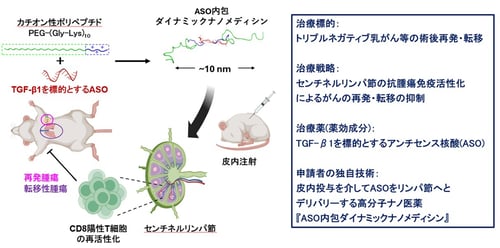
カチオン性ポリペプチドの精密分子設計を通じて、1分子の核酸医薬を緩く内包するダイナミックナノメディシン(=ナノマシン)を新たに調製した。皮内投与されたナノメディシンは効率よくセンチネルリンパ節へと核酸医薬を送達し、免疫細胞の活性化を通じてがん免疫療法を強化することができる。
<関連情報>
- https://www.t.u-tokyo.ac.jp/press/pr2025-06-24-001
- https://www.t.u-tokyo.ac.jp/hubfs/press-release/2025/0624/001/text.pdf
- https://pubs.acs.org/doi/10.1021/jacs.5c04234
抗がん剤による乳がんの再発・転移を抑制するためのセンチネルリンパ節へのアンチセンスオリゴヌクレオチドの送達を構造的に動的なポリプレックスが促進する Structurally Dynamic Polyplexes Enhance Sentinel Lymph Node Delivery of Antisense Oligonucleotides to Inhibit Breast Cancer Recurrence and Metastasis
Chun Yin Jerry Lau,Hiroaki Kinoh,Xueying Liu,Jiayuan Feng,Fadlina Aulia,Kaori Taniwaki,Nan Qiao,Satomi Ogura,Mitsuru Naito,and Kanjiro Miyata
Journal of the American Chemical Society Published: June 20, 2025
DOI:https://doi.org/10.1021/jacs.5c04234
Abstract
Sentinel lymph nodes (SLNs), the first tumor-draining lymph nodes, play a prominent role in tumor progression. Cytotoxic CD8+ T cells in the SLN are typically suppressed in advanced cancer but, when rejuvenated, can slow cancer progression. Here, we demonstrated a molecular approach to engineering a dynamic polyplex, predominantly comprising two poly(ethylene glycol)-(glycine–lysine)10 [PEG-(GK)10] per antisense oligonucleotide (ASO) based on charge neutralization at a minimum molecular ratio, that can enhance SLN functional delivery of ASOs for replenishing immunity against breast cancer recurrence and metastasis. Using a murine breast cancer model, we successfully enriched the ASO distribution in the SLN while limiting off-target organ distribution by tuning the size of the PEG (3–80 kDa). Moreover, we obtained a less compact polyplex using conserved glycine–lysine repeats as cationic segments instead of conventional lysine repeats, resulting in improved structural dynamics and better target gene silencing efficiency in SLN. Polyplex with the optimized PEG size and dynamics was subsequently utilized to develop a regimen to deplete the transforming growth factor-β1 (TGF-β1) level in the SLN. Consequently, we successfully rejuvenated the depleted CD8+ T cells in the SLNs, corresponding to reduced postoperative tumor relapse and lung metastasis. Our findings provide a molecular rationale to enable a simple but robust TGF-β1 ASO therapeutic regimen for managing advanced breast cancer.