2025-06-26 中国科学院(CAS)
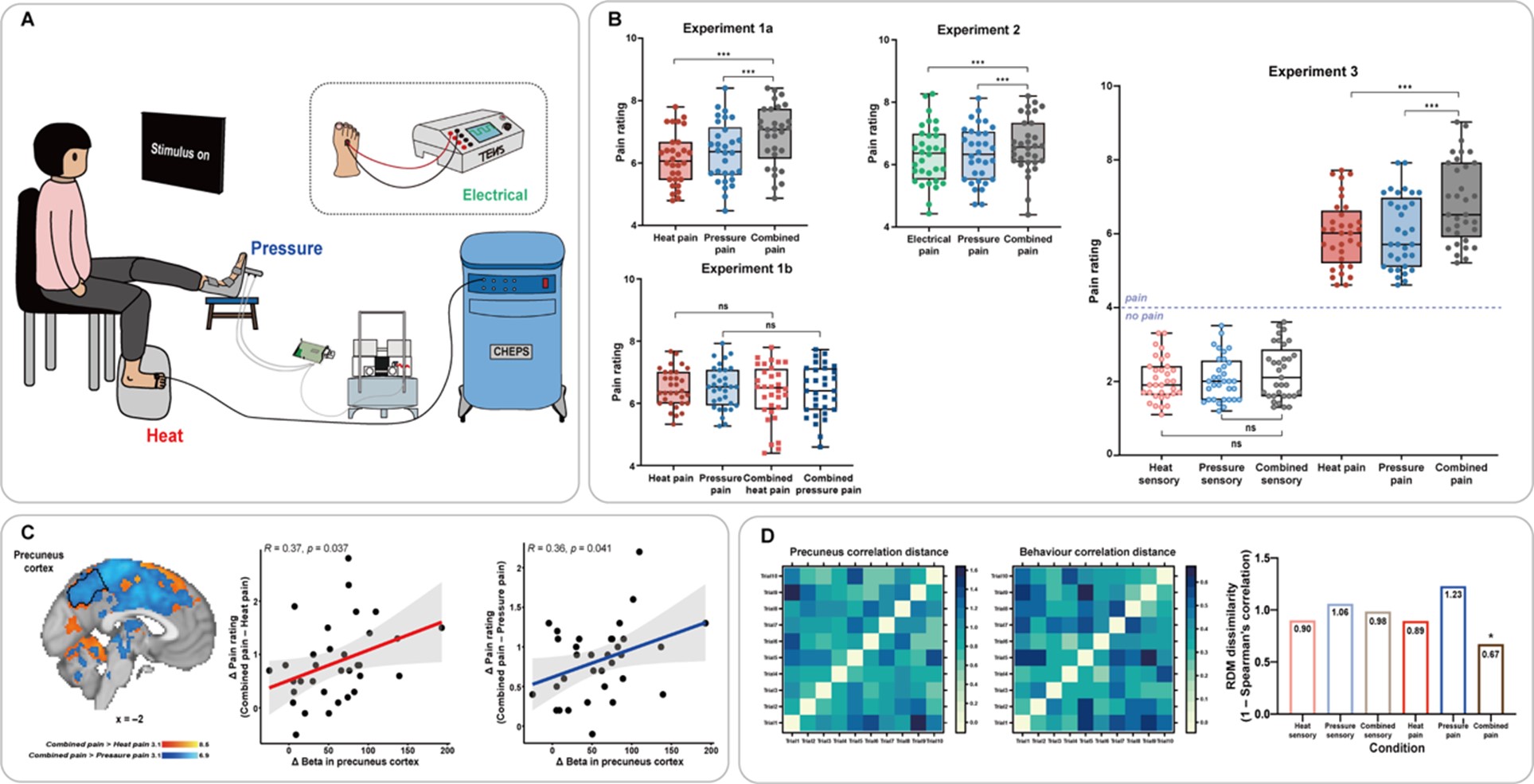
A. Experimental setup; B. Significant difference between combined pain rating and single-modal pain rating under perceptual instruction; C. Positive correlation between the increased activation in the precuneus and the integration effect of pain perception; D. Strong similarities between the brain activity in the precuneus and participants’ pain perception for combined pain condition. (Image by KONG Yazhuo)
<関連情報>
- https://english.cas.cn/newsroom/research_news/life/202506/t20250626_1046277.shtml
- https://royalsocietypublishing.org/doi/10.1098/rspb.2025.1229
Pain integration of multimodal noxious stimulation based on the perceptual instruction
Yu Zhang,Yongkang Zhi,Yu Zhang,Qiushi Li,Ming ZhangandYazhuo Kong
Proceedings of the Royal Society B Published:25 June 2025
DOI:https://doi.org/10.1098/rspb.2025.1229
Abstract
Individuals encounter various somatosensory inputs in their daily lives, often in multiple forms at once. When exposed to noxious stimuli, the intensity of these inputs can lead to a complex experience of pain. However, the mechanisms by which these harmful stimuli combine into a unified pain experience remain unclear. Understanding this process is essential for comprehending pain perception in challenging situations. Here, we investigated pain integration through four experiments involving multimodal noxious stimuli—heat, pressure, and electrical inputs—applied to the feet, instructed by perceptual cues. We found that pain integration—rather than somatosensory inputs—significantly enhanced overall pain perception. Notably, this effect was not simply due to the additive nature of the stimuli. Our imaging results indicated that pain integration involved the precuneus cortex, with connectivity between the precuneus and both the angular gyrus and lateral occipital cortex playing a vital role in the integration process. Furthermore, we observed strong similarities between the brain activity in the precuneus and participants’ pain perception, highlighting the unique function of this area during pain integration. These findings provide crucial evidence of how the brain integrates responses to multimodal noxious stimuli, underscoring an important clinical consideration for pain management strategies.