2025-06-26 バース大学
<関連情報>
- https://www.bath.ac.uk/announcements/new-iq-research-shows-why-smarter-people-make-better-decisions/
- https://psycnet.apa.org/fulltext/2026-26993-001.html
IQ、遺伝子、そして誤算された期待 IQ, Genes, and Miscalibrated Expectations
Chris Dawson
Journal of Personality and Social Psychology Accepted: May 13, 2025
DOI:https://doi.org/10.1037/pspp0000567

Abstract
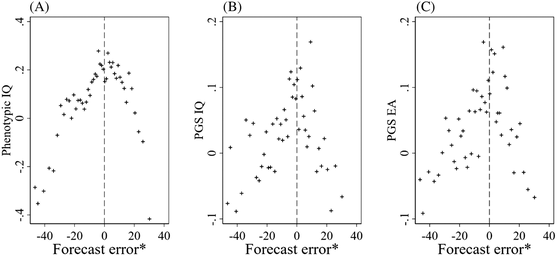
Almost all formal models of decision making under uncertainty require agents to judge the likelihood of relevant uncertainties. Typically, decisions are best made when these judgments are accurate. In the context of probabilistic subjective survival expectations, from a nationally representative English sample of participants aged over 50 (N = 3,946), we test whether IQ is associated with calibration. We find strong evidence that high-IQ respondents make substantially lower forecast errors and produce less noise in their predictions than low-IQ respondents. These results are confirmed when we leverage the randomness in genetic variants linked to IQ as an instrumental variable (Mendelian randomization) and when directly using participants’ genetic variants related to educational attainment—that captures IQ as well as other cognitive and noncognitive traits relevant to educational success. These results highlight important channels through which IQ contributes to beliefs about the world and may explain why low IQ is often linked to poor financial decision making, lower economic growth and economic welfare, and judgmental biases.