2025-06-30 京都大学
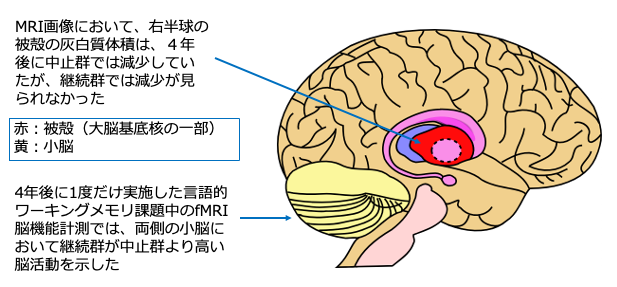
本研究の概要(画像出典:Wikipedia「Putamen」 © CC BY-SA 4.0(一部改変あり))
<関連情報>
- https://www.kyoto-u.ac.jp/ja/research-news/2025-06-30
- https://www.kyoto-u.ac.jp/sites/default/files/2025-06/web_2506_Sekiyama-c1a09ed81d7f9c2210727d42ceb9ac6c.pdf
- https://direct.mit.edu/imag/article/doi/10.1162/IMAG.a.48/131155/Never-too-late-to-start-musical-instrument
楽器トレーニングに遅すぎることはない: 健康な高齢者におけるワーキングメモリと皮質下保存に対する4年間の効果 Never too late to start musical instrument training: Effects on working memory and subcortical preservation in healthy older adults across 4 years
Xueyan Wang,Masatoshi Yamashita,Xia Guo,Lars Stiernman,Marcelo Kakihara,Nobuhito Abe,Kaoru Sekiyama
Imaging Neuroscience Published:June 17 2025
DOI:https://doi.org/10.1162/IMAG.a.48
Abstract
Studies have shown the beneficial effects of musical instrument on memory and executive function in healthy aging. However, few studies investigated these long-term benefits. In this regard, the current study tracked a cohort of older adults (n = 53) over 4 years after they have initially participated in a musical instrument training program. Out of the initial sample, 13 of them voluntarily continued participating in the musical instrument training (continue group: 77.85 ± 4.30 years, 10 female, 3 male), while 19 of them discontinued their participation in the music program and instead engaged in other forms of leisure activities (stop group: age: 76.00 ± 5.44 years, 13 female, 6 male). At baseline, behavioral measures of verbal working memory (WM), verbal memory, and executive control were collected. In addition, participants completed a visual WM task (face n-back task) during fMRI scanning. Four years later, the same battery of tests was administered, with the addition of a digit n-back task to examine changes in verbal WM. Region-of-interest structural analyses focused on the striatum and cerebellum, based on previously reported intervention effects and the advantages observed in musicians. The continue group demonstrated better preservation of verbal WM performance (a composite score of Digit Span and Verbal Fluency tasks) and right putamen gray matter volume (GMV) over 4 years. During verbal WM processing, this group exhibited lower cerebellum–pons functional connectivity (FC), which significantly correlated with improved verbal WM performance. Moreover, the continue group also showed greater cerebellar activation during the digit task, increased intra-cerebellar FC, and decreased cerebellar–cortical FC during the face task. The combined evidence suggested enhanced cerebellar function and thus reduced reliance on other brain regions such as the cortical areas and brainstem for compensation. Taken together, these results suggested the musical instrument training effects in mitigating age-related decline in verbal WM and subcortical structure (putamen) and function (cerebellum). This study provides longitudinal evidence that initiating musical instrument training in older adulthood can counteract age-related cognitive and brain decline.