2025-07-11 京都大学
Illustrated by Hiroko Uchida
<関連情報>
- https://www.kyoto-u.ac.jp/ja/research-news/2025-07-11-1
- https://www.kyoto-u.ac.jp/sites/default/files/2025-07/web_2507_Uemura-bd331452632f7351316894d579a2a319.pdf
- https://www.embopress.org/doi/full/10.1038/s44319-025-00503-8
成長期食はショウジョウバエ雄のヒストンアセチルトランスフェラーゼGcn5の機能を低下させ寿命を縮める Growth phase diets diminish histone acetyltransferase Gcn5 function and shorten lifespan of Drosophila males
Shoko Mizutani, Kanji Furuya, Ayumi Mure, Yuuki Takahashi, Akihiro Mori, Nozomu Sakurai, Takuto Suito, Kohjiro Nagao, Masato Umeda, Kaori Watanabe, Yukako Hattori, and Tadashi Uemura
EMBO reports Published:10 July 2025
DOI:https://doi.org/10.1038/s44319-025-00503-8
Abstract
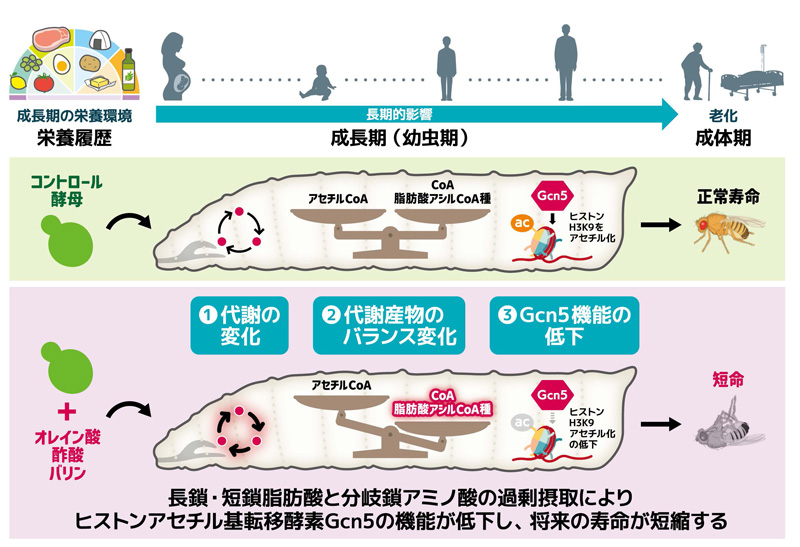
The nutritional environment in early life, referred to as the nutrition history, exerts far-reaching health effects beyond the developmental stage. Here, with Drosophila melanogaster as a model, we fed larvae on diets consisting of a variety of yeast mutants and explored the resulting histories that impacted adult lifespan. A larval diet comprised of yeast nat3 KO shortened the lifespan of male adults; and remarkably, this diet diminished the function of histone acetyltransferase Gcn5 in larvae. Concordantly, perturbation of Gcn5-mediated gene regulation in the larval whole body or neurons significantly contributed to the earlier death of adults. The nat3 KO diet is much more abundant in long-chain fatty acids and branched-chain amino acids (BCAAs) than the control yeast diet. Supplementing the control diet with a combination of oleic acid, valine, and acetic acid recapitulated the effects of the nat3 KO diet on the larval transcriptome and the lifespan of males. Our findings strongly suggest a causal link between a fatty acids- and BCAA-rich diet in developmental stages and lifespan reduction via the adverse effect on the Gcn5 function.