2025-07-11 マックス・プランク研究所(MPG)
<関連情報>
- https://www.mpg.de/25039233/0709-evan-neandertal-variant-reduces-activity-of-a-key-muscle-enzyme-150495-x
- https://www.nature.com/articles/s41467-025-61605-4
ネアンデルタール人の筋肉AMPデアミナーゼ活性は現代人より低かった Muscle AMP deaminase activity was lower in Neandertals than in modern humans
Dominik Macak,Shin-Yu Lee,Tomas Nyman,Henry Ampah-Korsah,Emilia Strandback,Svante Pääbo & Hugo Zeberg
Nature Communications Published:10 July 2025
DOI:https://doi.org/10.1038/s41467-025-61605-4
Abstract
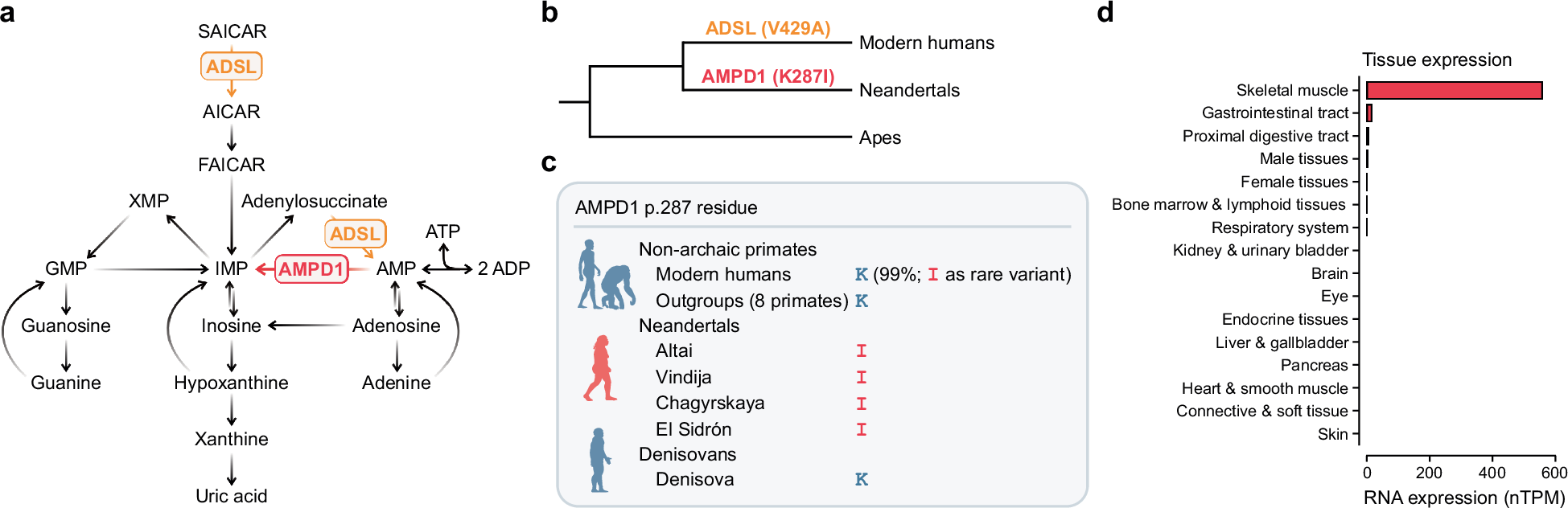
The enzyme AMPD1 is expressed in skeletal muscle and is involved in ATP production. All available Neandertal genomes carry a lysine-to-isoleucine substitution at position 287 in AMPD1. This variant, which occurs at an allele frequency of 0–8% outside Africa, was introduced to modern humans by gene flow from Neandertals. Here, we show that the catalytic activity of the purified Neandertal AMPD1 is ~25% lower than the ancestral enzyme, and when introduced in mice, it reduces AMPD activity in muscle extracts by ~80%. Among present-day Europeans, another AMPD1 variant encoding a stop codon occurs at an allele frequency of 9–14%. Individuals heterozygous for this variant are less likely to be top-performing athletes in various sports, but otherwise reduced AMPD1 activity is well tolerated in present-day humans. While being conserved among vertebrates, AMPD1 seems to have become less functionally important among Neandertals and modern humans.