2025-07-18 NASA
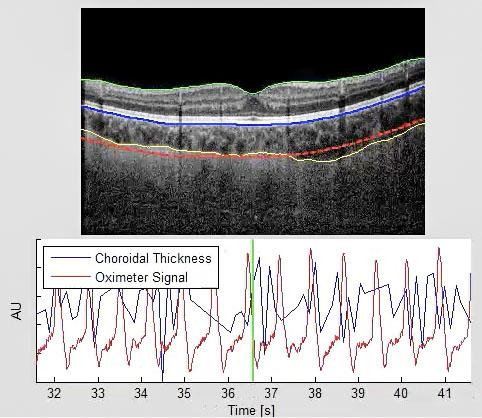
Optical coherence tomography image of the back of the eyeball (top) and thickness of the middle wall of the eye (bottom) from the SANSORI investigation. University of Montreal
<関連情報>
- https://www.nasa.gov/missions/station/iss-research/vision-changes-on-space-station/
- https://www.mdpi.com/1422-0067/25/22/12041
- https://ieeexplore.ieee.org/document/10666778
- https://jamanetwork.com/journals/jamaophthalmology/fullarticle/2821259#google_vignette
- https://www.sciencedirect.com/science/article/abs/pii/S0039625722000480
人工重力は視神経と網膜の宇宙飛行に対するトランスクリプトーム応答を抑制する Artificial Gravity Attenuates the Transcriptomic Response to Spaceflight in the Optic Nerve and Retina
Isaac Kremsky,Reyna Pergerson,Stephen Justinen,Seta Stanbouly,Jeffrey Willey,Charles A. Fuller,Satoru Takahashi,Martha Hotz Vitaterna,Mary Bouxsein and Xiaowen Mao
International Journal of Molecular Sciences Published: 9 November 2024
DOI:https://doi.org/10.3390/ijms252212041
長期宇宙飛行に対する眼生体力学的反応 Ocular Biomechanical Responses to Long-Duration Spaceflight
Marissé Masís Solano; Remy Dumas; Mark R Lesk; Santiago Costantino
IEEE Open Journal of Engineering in Medicine and Biology Published:05 September 2024
DOI:https://doi.org/10.1109/OJEMB.2024.3453049
Impact Statement:::
Long-term space missions significantly reduce ocular rigidity and ocular pulse amplitude, revealing microgravity-induced changes in eye mechanics and advancing understanding of Spaceflight-Associated Neuro-ocular Syndrome (SANS).
Abstract:
Objective: To assess the impact of microgravity exposure on ocular rigidity (OR), intraocular pressure (IOP), and ocular pulse amplitude (OPA) following long-term space missions. OR was evaluated using optical coherence tomography (OCT) and deep learning-based choroid segmentation. IOP and OPA were measured with the PASCAL Dynamic Contour Tonometer (DCT). Results: The study included 26 eyes from 13 crew members who spent 157 to 186 days on the International Space Station. Post-mission results showed a 25% decrease in OPA (p < 0.005), an 11% decrease in IOP from 16.0 mmHg to 14.2 mmHg (p = 0.04), and a 33% reduction in OR (p = 0.04). No significant differences were observed between novice and experienced astronauts. Conclusions: These findings reveal previously unknown effects of microgravity on the eye’s mechanical properties, contributing to a deeper understanding of Spaceflight-Associated Neuro-ocular Syndrome (SANS). Long-term space missions significantly alter ocular biomechanics and have the potential to become biomarkers of disease progression.
2つの素因を持つ宇宙飛行士における重篤な宇宙飛行関連神経眼症候群 Severe Spaceflight-Associated Neuro-Ocular Syndrome in an Astronaut With 2 Predisposing Factors
Tyson J. Brunstetter, OD, PhD; Sara R. Zwart, PhD; Keith Brandt, MD; et al
JAMA Ophthalmology Published:July 25, 2024
DOI:10.1001/jamaophthalmol.2024.2385
Key Points
Question Why did a female astronaut present with more severe spaceflight-associated neuro-ocular syndrome (SANS) findings than previous astronauts?
Findings This individual with 2 potentially predisposing risk factors developed the largest change in peripapillary total retinal thickness and hyperopic shift during a single mission, with inflight improvement potentially associated with B-vitamin supplementation or reduction in cabin carbon dioxide.
Meaning Results suggest that possessing 2 predisposing risk factors may explain the severe development of SANS findings; the rarity of this presentation warrants consideration of treatment options.
Abstract
Importance Understanding potential predisposing factors associated with spaceflight-associated neuro-ocular syndrome (SANS) may influence its management.
Objective To describe a severe case of SANS associated with 2 potentially predisposing factors.
Design, Setting, and Participants Ocular testing of and blood collections from a female astronaut were completed preflight, inflight, and postflight in the setting of the International Space Station (ISS).
Exposure Weightlessness throughout an approximately 6-month ISS mission. Mean carbon dioxide (CO2) partial pressure decreased from 2.6 to 1.3 mm Hg weeks before the astronaut’s flight day (FD) 154 optical coherence tomography (OCT) session. In response to SANS, 4 B-vitamin supplements (vitamin B6, 100 mg; L-methylfolate, 5 mg; vitamin B12, 1000 μg; and riboflavin, 400 mg) were deployed, unpacked on FD153, consumed daily through FD169, and then discontinued due to gastrointestinal discomfort.
Main Outcomes and Measures Refraction, distance visual acuity (DVA), optic nerve, and macular assessment on OCT.
Results Cycloplegic refraction was -1.00 diopter in both eyes preflight and +0.50 - 0.25 × 015 in the right eye and +1.00 diopter in the left eye 3 days postflight. Uncorrected DVA was 20/30 OU preflight, 20/16 or better by FD90, and 20/15 OU 3 days postflight. Inflight peripapillary total retinal thickness (TRT) peaked between FD84 and FD126 (right eye, 401 μm preflight, 613 μm on FD84; left eye, 404 μm preflight, 636 μm on FD126), then decreased. Peripapillary choroidal folds, quantified by surface roughness, peaked at 12.7 μm in the right eye on FD154 and 15.0 μm in the left eye on FD126, then decreased. Mean choroidal thickness increased throughout the mission. Genetic analyses revealed 2 minor alleles for MTRR 66 and 2 major alleles for SHMT1 1420 (ie, 4 of 4 SANS risk alleles). One-week postflight, lumbar puncture opening pressure was normal, at 19.4 cm H2O.
Conclusions and Relevance To the authors’ knowledge, no other report of SANS documented as large of a change in peripapillary TRT or hyperopic shift during a mission as in this astronaut, and this was only 1 of 4 astronauts to experience chorioretinal folds approaching the fovea. This case showed substantial inflight improvement greater than the sensitivity of the measure, possibly associated with B-vitamin supplementation and/or reduction in cabin CO2. However, as a single report, such improvement could be coincidental to these interventions, warranting further evaluation.
宇宙飛行関連神経眼症候群(SANS)の神経眼画像と視覚評価技術 Neuro-ophthalmic imaging and visual assessment technology for spaceflight associated neuro-ocular syndrome (SANS)
Joshua Ong BS, Alireza Tavakkoli PhD, Gary Strangman PhD, Nasif Zaman MS, Sharif Amit Kamran MS, Quan Zhang PhD, Vladimir Ivkovic PhD, Andrew G. Lee MD
Survey of Ophthalmology Available online: 21 April 2022
DOI:https://doi.org/10.1016/j.survophthal.2022.04.004
Abstract
Spaceflight associated neuro-ocular syndrome (SANS) refers to a unique collection of neuro-ophthalmic clinical and imaging findings observed in astronauts after long-duration spaceflight. Current in-flight and postflight imaging modalities (e.g., optical coherence tomography, orbital ultrasound, and funduscopy) have played an instrumental role in the understanding and monitoring of SANS development; however, the precise etiology for this neuro-ophthalmic phenomenon is still not completely understood. SANS may be a potential barrier to future deep space missions, and therefore it is critical to further elucidate the underlying pathophysiology for effective countermeasures. The complexity and unique limitations of spaceflight require careful consideration and integration of leading technology to advance our knowledge of this extraterrestrial syndrome. We describe the current neuro-ophthalmic imaging modalities and hypotheses that have improved our current understanding of SANS, discuss newer developments in SANS imaging (including noninvasive near-infrared spectroscopy) and summarize emerging research in the development of an aspirational future head-mounted virtual reality display with multimodal visual assessment technology for the detection of neuro-ocular findings in SANS.