2025-07-22 国立成育医療研究センター
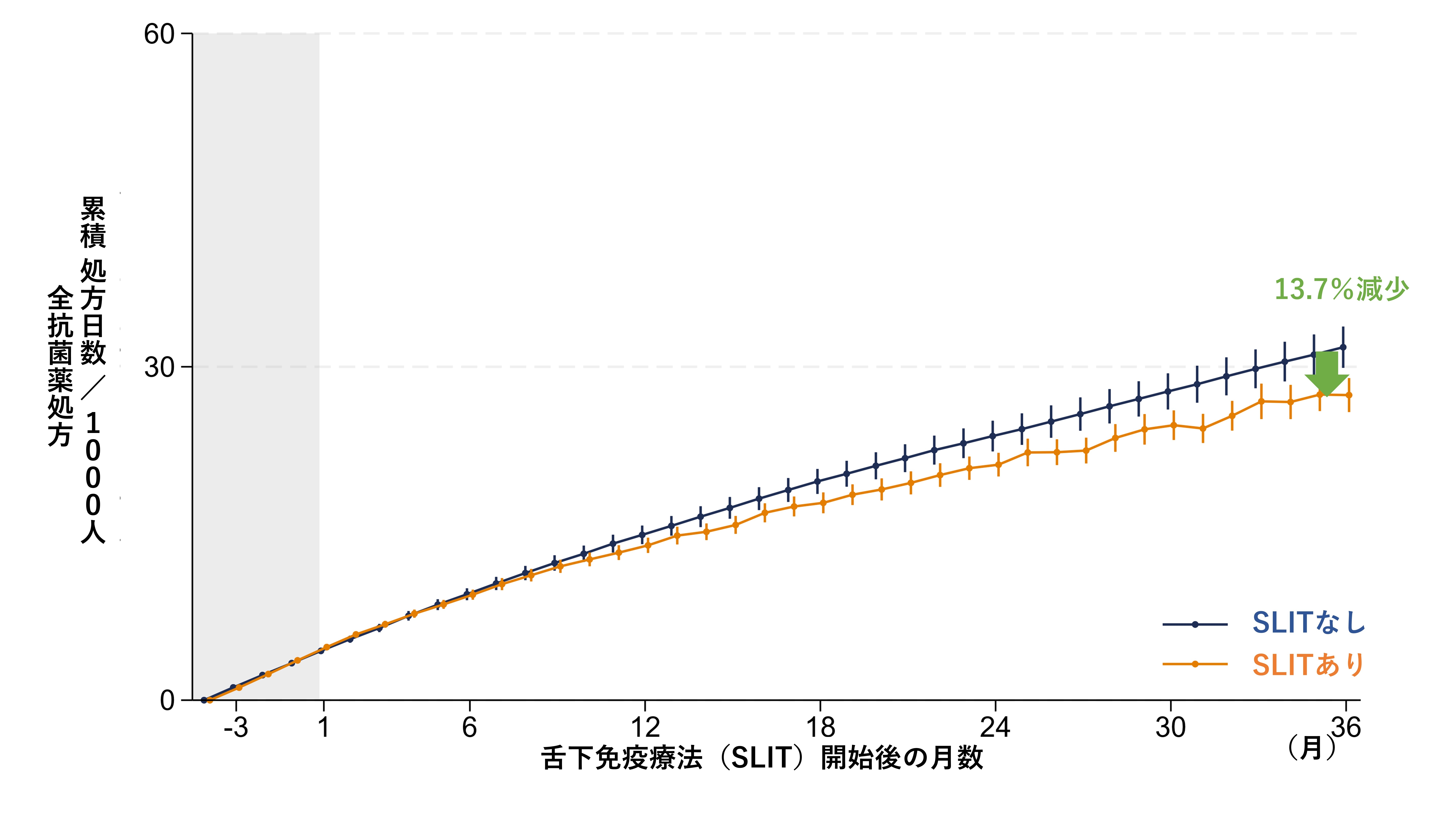
【図1:ダニ舌下免疫療法が全抗菌薬処方に与えた影響】
<関連情報>
- https://www.ncchd.go.jp/press/2025/0722.html
- https://www.ncchd.go.jp/press/2025/0722.pdf
- https://onlinelibrary.wiley.com/doi/10.1111/all.16646
学童期・思春期における舌下アレルゲン免疫療法の実際の有効性 Real-World Effectiveness for Sublingual Allergen Immunotherapy Among School-Aged Children and Adolescents
Yusuke Okubo, Yu Kuwabara, Sakura Sato, Masafumi Sakashita, Hideaki Morita
Allergy Published: 09 July 2025
DOI:https://doi.org/10.1111/all.16646
ABSTRACT
Background
Sublingual allergen immunotherapy (SLIT) is a safe and effective treatment of allergic rhinitis, and its use has been increasing in recent years. Although several randomized and observational studies showed the effectiveness of SLIT among adults and children aged > 12 years, its extent remains unclear in nationwide routine healthcare settings for school-aged children.
Methods
We conducted a propensity score (PS)-matched cohort study using a nationwide administrative database. Data from 13,449 individuals who received SLIT for house dust mites between 2015 and 2021 were extracted and matched with data from 1,732,961 individuals who did not. The PS-matching procedure created 10,985 pairs and followed them for three years, totaling 812,795 person-months. Then, we compared healthcare costs, resource use, and prescriptions between the SLIT and control groups over the three years.
Results
The introduction of SLIT was associated with an 8.9% reduction in antibiotic use (95% CI, 12.0% to 34.7%) and a 65.2% reduction in hospitalizations (95% CI, 52.8% to 74.4%), as well as a 44.1% increase in health resource utilization (95% CI, 40.7% to 47.6%), with minimal impact on overall healthcare costs (+8.9% [95% CI, -12.0% to +34.7%]) over the three-year follow-up period. Similar findings were observed in event-study design and intention-to-treat analyses, as well as in age-stratified analyses (ages 5–10 years and 11–19 years).
Conclusions
The introduction of SLIT for house dust mites was associated with a reduction in antibiotic prescriptions and hospitalizations among children aged 5–19 years with minimal impact on healthcare costs, demonstrating sustained benefits over three years.
Graphical Abstract
This study used a nationwide database to investigate the associations between SLIT introduction and clinical outcomes among children over 5 years of age. The PS-matching procedure created 10,985 pairs and followed them for three years. The introduction of SLIT associated with an 8.9% reduction in antibiotic use and a 65.2% reduction in hospitalizations with minimal impact on overall healthcare costs (+8.9%) over the three-year follow-up period.