2025-07-24 東京大学
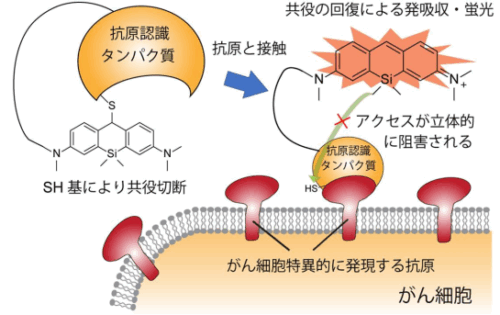
開発したがん表面抗原検出プローブの概要。抗原結合前には蛍光が OFF で、抗原結合後に蛍光が ON になる。
<関連情報>
タンパク質-染料ハイブリッドの分子内付加反応を利用した抗原標的型蛍光プローブの設計 Design of Antigen-Targeting Fluorogenic Probes Utilizing Intramolecular Addition Reaction of Protein-Dye Hybrids
Mamiko Nakadate,Ryosuke Kojima,Naoki Seike,Ryo Tachibana,Kyohhei Fujita,Reiko Tsuchiya,Mako Kamiya,Andreas Plückthun,and Yasuteru Urano
Journal of the American Chemical Society Published:Published July 23, 2025
DOI:https://doi.org/10.1021/jacs.5c04193
Abstract
Fluorogenic probes for antigens are useful for various purposes, including medical diagnostics and imaging, but achieving a rapid, large fluorescence increase is difficult. Here, we report a new class of fluorogenic probes for antigens based on a conjugate of an antibody-mimetic DARPin bearing a site-specifically incorporated cysteine and silicon-pyronine (SiP), which reacts reversibly with thiols. By using a library-screening approach, we found that the fluorescence of SiP conjugated to a DARPin is quenched via π-deconjugating addition reaction of the cysteine installed in the DARPin to SiP. Upon antigen binding, the equilibrium of this reaction is shifted to dissociation, restoring π-conjugation in the SiP and resulting in a large increase in fluorescence. As proof of concept of this chemical design principle, we constructed fluorogenic probes targeting GFP and EpCAM, which showed 25- and 12-fold fluorescence increases upon binding, respectively. The latter probe enabled wash-free cancer cell imaging with a low background.