2025-07-24 京都大学iPS細胞研究所
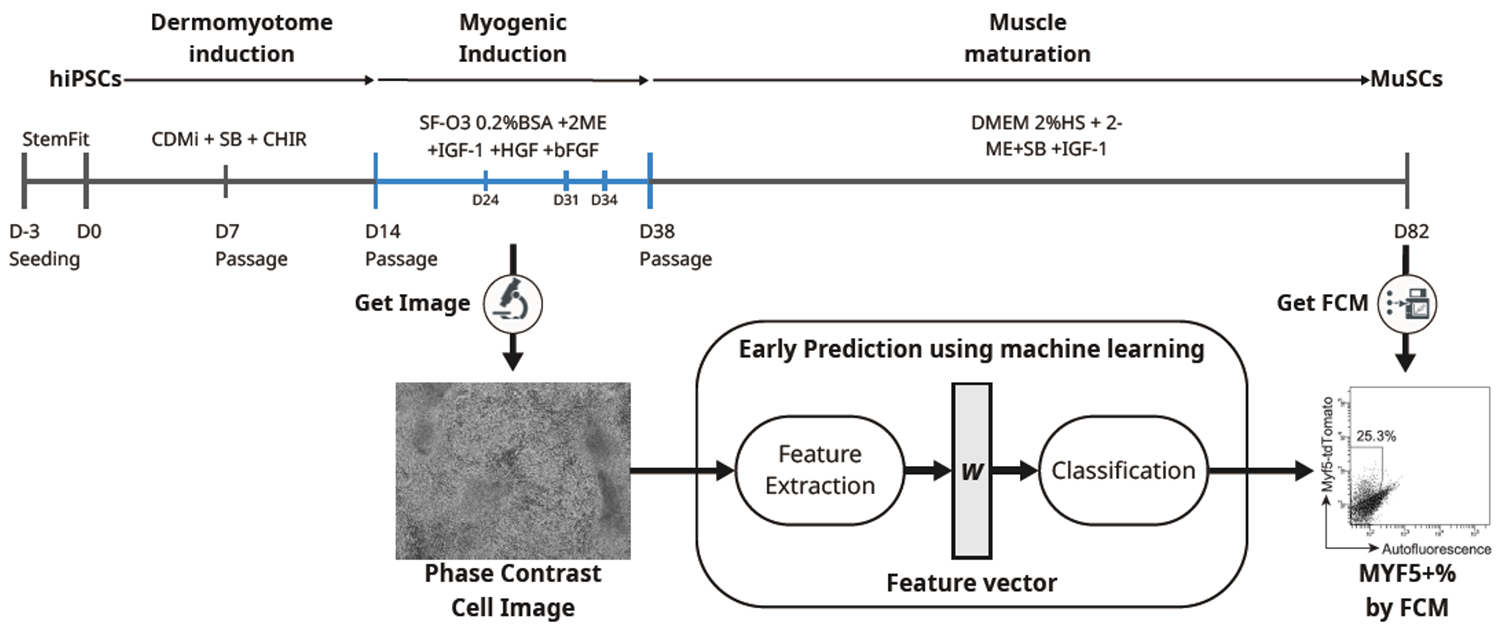 図1:本研究の概要
骨格筋幹細胞(MuSC)の分化誘導系(上部)をモデルとし、細胞画像から分化効率を予測するシステムを開発した。機械学習を用いて、14~38日目に取得した画像から82日目の分化効率の予測を行った。
<関連情報>
- https://www.cira.kyoto-u.ac.jp/j/pressrelease/news/250724-100000.html
- https://www.nature.com/articles/s41598-025-11108-5
画像解析と機械学習を用いたヒト誘導多能性幹細胞の分化効率の早期かつ非破壊的な予測 Early and non-destructive prediction of the differentiation efficiency of human induced pluripotent stem cells using imaging and machine learning
Miki Arai Hojo,Taku Tsuzuki,Yosuke Ozawa,Toshiyuki Araki & Hidetoshi Sakurai
Scientific Reports Published:23 July 2025
DOI:https://doi.org/10.1038/s41598-025-11108-5
Abstract
The reproducibility and robustness of many directed differentiation protocols from human induced pluripotent stem cells (hiPSCs) remain low, and the long differentiation induction period significantly limits protocol optimization. To address this, we developed an early and non-destructive prediction system for the differentiation induction efficiency of hiPSCs using bioimage informatics. We employed a directed differentiation protocol for muscle stem cells (MuSCs), a promising cell source for the regenerative therapy of muscular dystrophy. Biological analyses suggested that days 14–38 are positive for forecasting the induction efficiency on day 82. Therefore, we conducted six independent experiments, inducing MuSC differentiation in a total of 34 wells, and captured a total of 5,712 phase contrast cell images between days 14 and 38. We selected Fast Fourier transform (FFT) as the feature extraction method and confirmed that it captures the characteristics of cells during differentiation. By classifying images on each day using extracted features and machine learning, we found that samples with high and low induction efficiency could be predicted at approximately 50 days before the end of induction. This system is expected to contribute to regenerative therapy through effective protocol optimization.