2025-07-30 ユニバーシティ・カレッジ・ロンドン(UCL)
<関連情報>
- https://www.ucl.ac.uk/news/2025/jul/vagus-nerve-stimulation-could-help-people-get-more-exercise
- https://academic.oup.com/eurheartj/article/46/17/1634/8023896
健常者における非侵襲的迷走神経刺激と運動能力:無作為化試験 Non-invasive vagus nerve stimulation and exercise capacity in healthy volunteers: a randomized trial
Gareth L Ackland , Amour B U Patel , Stuart Miller , Ana Gutierrez del Arroyo , Jeeveththaa Thirugnanasambanthar , Jeuela I Ravindran , Johannes Schroth , James Boot , Laura Caton , Chas A Mein …
European Heart Journal Published:19 February 2025
DOI:https://doi.org/10.1093/eurheartj/ehaf037
Abstract
Background and Aims
Vagal parasympathetic dysfunction is strongly associated with impaired exercise tolerance, indicating that coordinated autonomic control is essential for optimizing exercise performance. This study tested the hypothesis that autonomic neuromodulation by non-invasive transcutaneous vagus nerve stimulation (tVNS) can improve exercise capacity in humans.
Methods
This single-centre, randomized, double-blind, sham-controlled, crossover trial in 28 healthy volunteers evaluated the effect of bilateral transcutaneous stimulation of vagal auricular innervation, applied for 30 min daily for 7 days, on measures of cardiorespiratory fitness (peak oxygen consumption (VO2peak)) during progressive exercise to exhaustion. Secondary endpoints included peak work rate, cardiorespiratory measures, and the whole blood inflammatory response to lipopolysaccharide ex vivo.
Results
tVNS applied for 30 min daily over 7 consecutive days increased VO2peak by 1.04 mL/kg/min (95% CI: .34–1.73; P = .005), compared with no change after sham stimulation (-0.54 mL/kg/min; 95% CI: -1.52 to .45). No carry-over effect was observed following the 2-week washout period. tVNS increased work rate (by 6 W; 95% CI: 2–10; P = .006), heart rate (by 4 bpm; 95% CI: 1–7; P = .011), and respiratory rate (by 4 breaths/min; 95% CI: 2–6; P < .001) at peak exercise. Analysis of the whole blood transcriptomic response to lipopolysaccharide in serial samples obtained from five participants showed that tVNS reduced the inflammatory response.
Conclusions
Non-invasive vagal stimulation improves measures of cardiorespiratory fitness and attenuates inflammation, offering an inexpensive, safe, and scalable approach to improve exercise capacity.
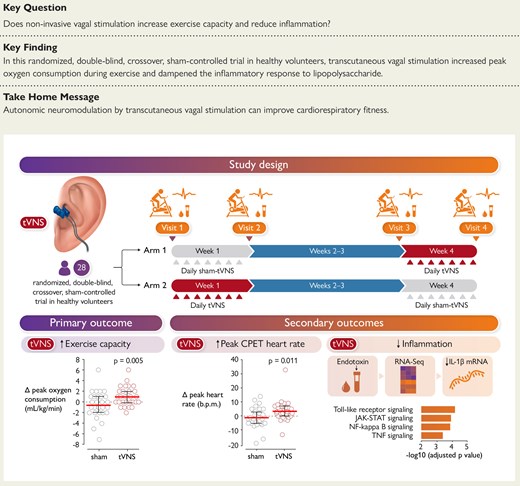
Structured Graphical Abstract
Methods, primary and secondary outcomes for randomized, double-blind, crossover, sham-controlled trial of non-invasive vagal stimulation in healthy volunteers. tVNS, transcutaneous vagus nerve stimulation; CPET, cardiopulmonary exercise test; RNAseq, RNA sequencing; IL-1β mRNA, interleukin-1 beta messenger RNA; JAK-STAT, Janus kinase signal transducer and activator of transcription; NF-kappa B, Nuclear factor kappa-light-chain-enhancer of activated B cells; TNF, tumour necrosis factor.