2025-07-28 マサチューセッツ工科大学(MIT)
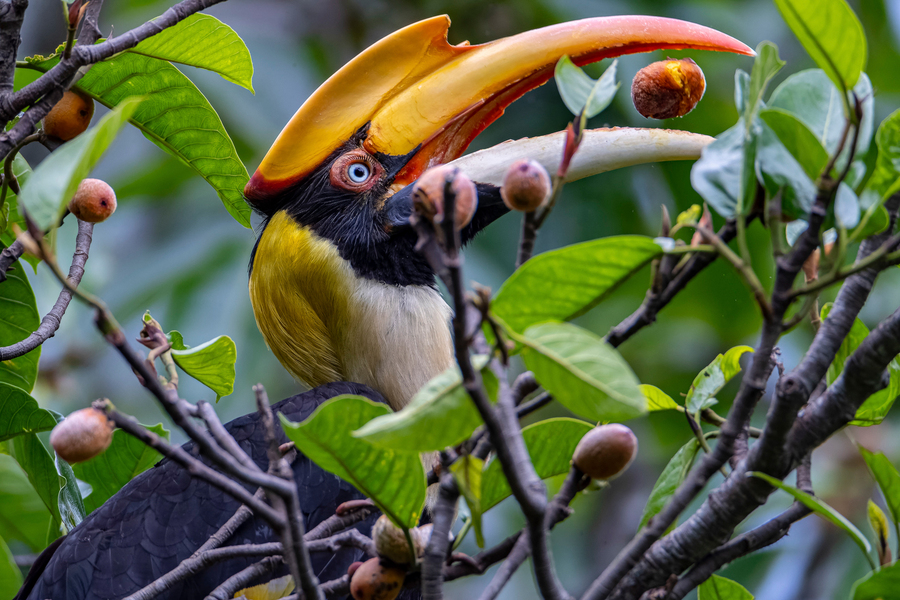
A great hornbill (Buceros bicornis) eats a fig in Royal Manas National Park, Bhutan. Hornbills are key long-distance seed dispersers in Asian tropical forests, but forest degradation, hunting, and wildlife trade threaten the ecological roles they play. Image credit: Christian Ziegler
<関連情報>
- https://news.mit.edu/2025/why-animals-are-critical-forest-carbon-absorption-0728
- https://www.pnas.org/doi/10.1073/pnas.2500951122
種子の分散阻害が熱帯林の再生を制限する Seed dispersal disruption limits tropical forest regrowth
Evan C. Fricke, Susan C. Cook-Patton, Charles F. Harvey, and César Terrer
Proceedings of the National Academy of Sciences Published:July 24, 2025
DOI:https://doi.org/10.1073/pnas.2500951122
Significance
Animal declines diminish the ecological roles they play in ecosystems. In the tropics, where regrowing forests can accumulate vast amounts of carbon, most trees rely on animals for seed dispersal—a key process in forest regeneration. However, whether disruption of seed dispersal by animals negatively impacts forest carbon recovery remains unclear. Evaluating this prediction using data from thousands of tropical sites, we show that forest carbon accumulation is strongly reduced where seed dispersal is disrupted. This finding highlights a critical but overlooked link between biodiversity loss and climate change, revealing how unmitigated animal declines undermine the ability of forest carbon to recover after disturbance and emphasizing the need to incorporate animal biodiversity into climate mitigation strategies.
Abstract
Identifying linkages between biodiversity loss and climate change is required for understanding the scope of these interconnected challenges and developing approaches to address them. One crucial yet underexplored aspect is the influence of seed-dispersing animals on forest carbon storage. Here, we show that 81% of tropical trees rely on animals for seed dispersal and that disruption of this process, due to declines in animal diversity and movement, significantly hampers the carbon accumulation potential of regrowing tropical forests. Using a synthesis of animal biodiversity, movement, and seed dispersal data covering thousands of animal species, we developed an index of seed dispersal disruption and modeled its relationship to carbon accumulation observed across 3,026 tropical regrowth plots. Naturally regrowing areas with lowest seed dispersal disruption had aboveground carbon accumulation rates four times higher than those with most severe disruption. Across areas identified as locations suitable for reforestation, current levels of seed dispersal disruption yield a 57% average reduction in local carbon accumulation potential. Tropical regrowth forests currently represent the largest land-based carbon sink; ongoing animal biodiversity losses diminish their ability to recover naturally from disturbances and therefore threaten their climate mitigation potential. These results advance understanding of animal biodiversity’s impact on carbon dynamics and emphasize the need to address biodiversity loss and climate change together.