2025-08-01 ブラウン大学
<関連情報>
- https://www.brown.edu/news/2025-08-01/alzheimers-biomarker
- https://direct.mit.edu/imag/article/doi/10.1162/IMAG.a.69/131452/High-power-transient-12-30-Hz-beta-event-features
高出力一過性12–30 Hzベータイベントはアルツハイマー病への転換の早期バイオマーカーとして機能する:MEG研究 High-power transient 12–30 Hz beta event features as early biomarkers of Alzheimer’s disease conversion: An MEG study
Danylyna Shpakivska-Bilan,Gianluca Susi,David W. Zhou,Jesus Cabrera,Blanca P. Carvajal,Ernesto Pereda,Maria Eugenia Lopez,Ricardo Bruña,Fernando Maestu,Stephanie R. Jones
Imaging Neuroscience Published:July 14 2025
DOI:https://doi.org/10.1162/IMAG.a.69
Abstract
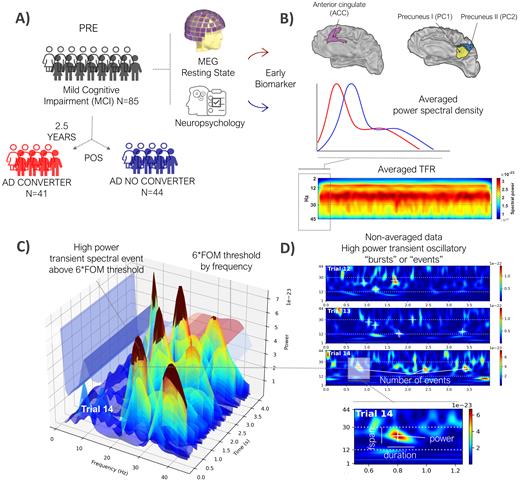
A typical pattern observed in M/EEG recordings of mild cognitive impairment (MCI) patients progressing to Alzheimer’s disease (AD) is a continuous slowing of brain oscillatory activity. Definitions of oscillatory slowing are imprecise, as they average across time and frequency bands, masking the finer structure in the signal and potential reliable biomarkers of the disease progression. Recent studies show that high averaged band power can result from transient increases in power, termed “events” or “bursts.” To better understand MEG oscillatory slowing in AD progression, we analyzed features of high-power oscillatory events and their relationship with cognitive decline. MEG resting-state oscillations were recorded in age-matched patients with MCI who later convert (CONV, N = 41) or do not convert (NOCONV, N = 44) to AD, in a period of 2.5 years. To distinguish future CONV from NOCONV, we characterized the rate, duration, frequency span, and power of transient high-power events in the alpha and beta band in two regions of interest in the “X” model of AD progression: anterior cingulate cortex (ACC) and precuneus (PC). Results revealed event-like patterns in resting-state power in both the alpha and beta bands, however, only beta-band features were predictive of conversion to AD, particularly in PC. Specifically, compared with NOCONV, CONV had a lower number of beta events, along with lower power events and a trend toward shorter duration events in PC (p<0.05). Beta event durations were also significantly shorter in ACC (p<0.01). Further, this reduced expression of beta events in CONV predicted lower values of mean relative beta power, increased probability of AD conversion, and poorer cognitive performance. Our work paves the way for reinterpreting M/EEG slowing and examining beta event features as a new biomarker along the AD continuum, and we discuss a potential link to theories of inhibitory control in neurodegeneration. These results may bring us closer to understanding the neural mechanisms of the disease that help guide new therapies.