2025-07-31 生命創成探究センター
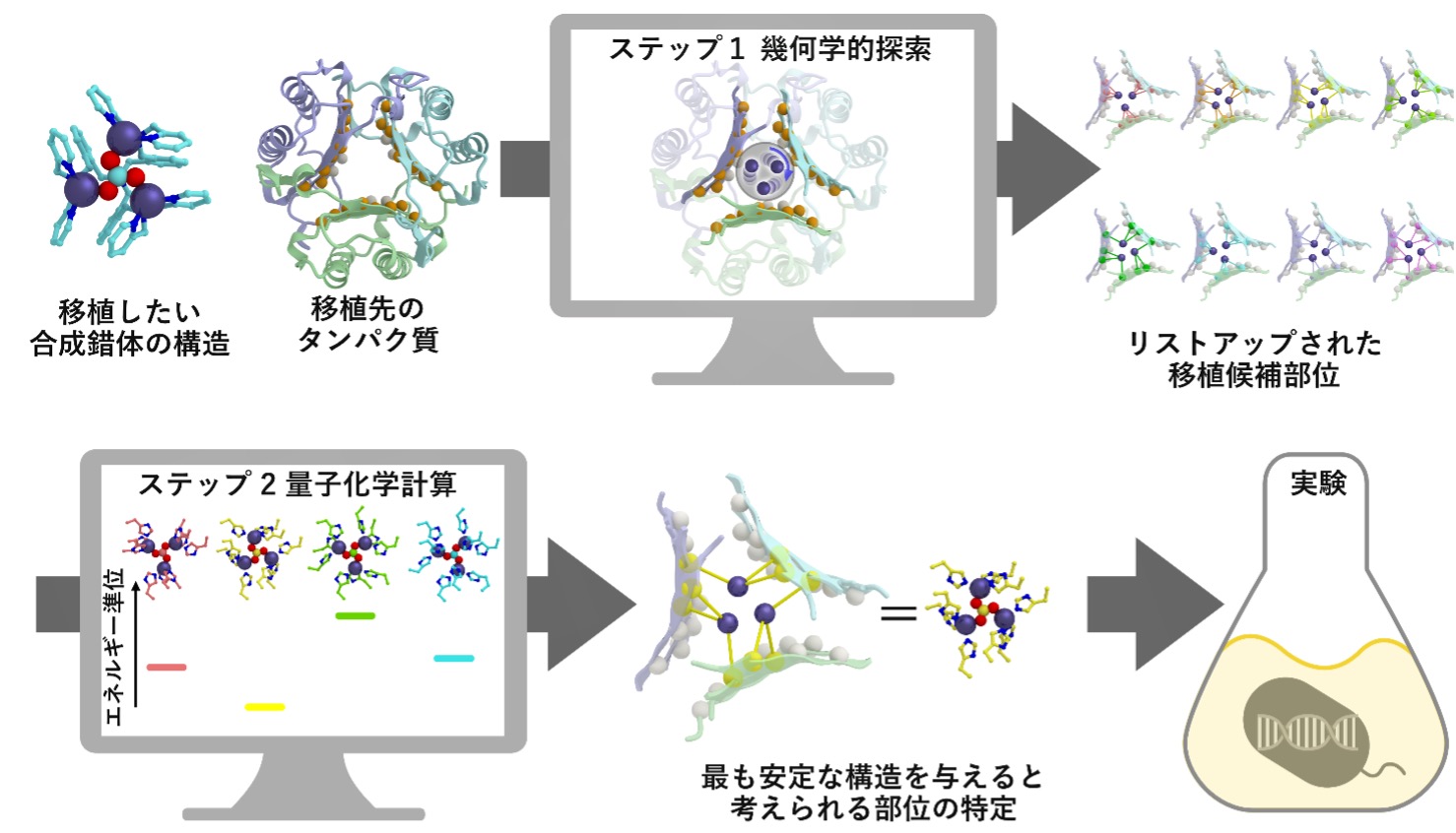
図1. 人工酵素デザインのワークフロー
ステップ1. 幾何学的探索による配位性アミノ酸の導入候補位置のリストアップ
ステップ2. リストアップした配置での量子化学計算による三核亜鉛構造の安定度の予測
<関連情報>
- https://www.excells.orion.ac.jp/news/12579
- https://www.excells.orion.ac.jp/wp/wp-content/uploads/2025/07/8b8c852cdaa63893f30adab854841da1.pdf
- https://www.nature.com/articles/s41467-025-61909-5
サイトカインを基盤としたデザイナー酵素は、非生物学的多核金属中心を有し、内在的および外在的な触媒作用を示す A cytokine-based designer enzyme with an abiological multinuclear metal center exhibits intrinsic and extrinsic catalysis
Akiko Ueno,Fumiko Takida,Tomoki Kita,Takuro Ishii,Tomoki Himiyama,Takuya Mabuchi & Yasunori Okamoto
Nature Communications Published:31 July 2025
DOI:https://doi.org/10.1038/s41467-025-61909-5
Abstract
A designer enzyme consisting of an abiological molecule incorporated into a natural protein has been developed as an exceptionally chemoselective catalyst, highlighting that the internal space of proteins is highly beneficial for enhancing catalytic performance. However, other features of proteins have received less attention in designer enzymes, for e.g., their use as ligands to construct abiological (multinuclear) metal centers and their intrinsic functions that have often been traded off for a new function. Here, grafting a synthetic trinuclear zinc complex inside a human cytokine macrophage migration inhibitory factor (MIF) scaffold using solely amino-acid side chains leads to a designer multi-metalloenzyme with extrinsic and intrinsic functions. The crystal structure of the designer tri-zinc enzyme verifies the accuracy of our design process based on geometry optimizations and quantum-chemical calculations. The extrinsic catalytic performance of this designer enzyme is of the highest class and comparable to that of previously reported designer zinc hydrolases. Importantly, an intrinsic function of MIF, i.e., its tautomerase activity, is maintained in this designer tri-zinc enzyme. Considering that cytokines are originally expressed in response to in vivo events, this cytokine-based designer metalloenzyme holds promising potential as a synthetic biological tool for the self-adaptive regulation of life phenomena.