2025-08-05 カロリンスカ研究所(KI)
<関連情報>
- https://news.ki.se/genes-reveal-why-some-older-people-suffer-from-frailty
- https://www.nature.com/articles/s43587-025-00925-y
プロテオミクス統合による大規模ゲノムワイド解析が、脆弱性に関する新たな遺伝子座と生物学的洞察を明らかにする Large-scale genome-wide analyses with proteomics integration reveal novel loci and biological insights into frailty
Jonathan K. L. Mak,Chenxi Qin,Moritz Krüger,Anna Kuukka,FinnGen,Sara Hägg,Jake Lin & Juulia Jylhävä
Nature Aging Published:05 August 2025
DOI:https://doi.org/10.1038/s43587-025-00925-y
Abstract
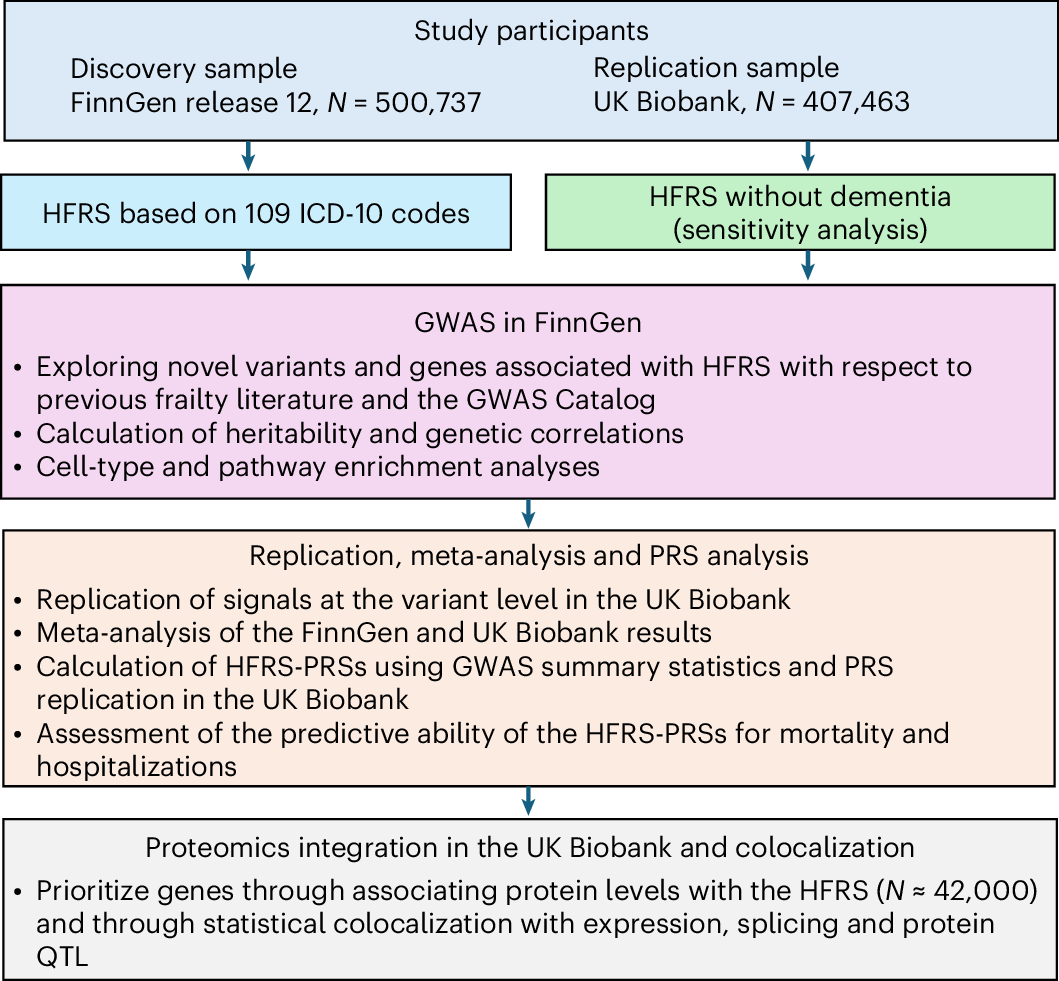
Frailty is a clinically relevant phenotype with notable gaps in our understanding of its etiology. Using the Hospital Frailty Risk Score (HFRS) to define frailty, we performed a genome-wide association study in FinnGen (N = 500,737), replicated the results in the UK Biobank (N = 407,463) and performed a meta-analysis. We prioritized genes through colocalization with expression, splicing and protein quantitative trait loci and proteomics integration. We identified 53 independent lead variants associated with frailty (P < 5 × 10⁻⁸), of which 45 were novel and not previously reported in the GWAS Catalog. Replication at the individual variant and polygenic risk score of the HFRS (P = 1.86 × 10-522) levels and meta-analysis largely confirmed the findings. Colocalization analysis supported a causal role for several genes, including CHST9, C6orf106 (ILRUN), KHK, MET, APOE, CGREF1 and PPP6C. Additionally, plasma levels of MET, CGREF1 and APOE were associated with HFRS. Our results reveal new genetic contributions to frailty and shed light on its biological basis.