2025-08-08 北海道大学
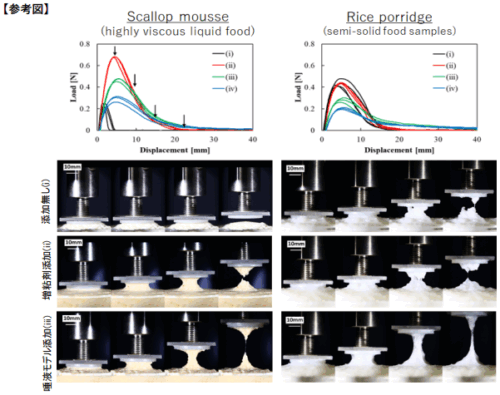
図 1.ホタテムース(左)と全粥(右)のプローブタック試験*1 、グラフの横軸はプローブの変位、縦軸はプローブに働く荷重を⽰している。
<関連情報>
- https://www.hokudai.ac.jp/news/2025/08/post-2015.html
- https://www.hokudai.ac.jp/news/pdf/250808_pr3.pdf
- https://www.sciencedirect.com/science/article/abs/pii/S0268005X25007763
嚥下の定量的評価に向けた嚥下障害食の粘着力試験 Adhesion testing of dysphagia diets for the quantitative evaluation of swallowing
Kosuke Takahashi, Ryo Yoshida, Kohei Ohie, Satomi Kumagai, Yuji Tasaka
Food Hydrocolloids Available online: 28 July 2025
DOI:https://doi.org/10.1016/j.foodhyd.2025.111816
Highlights
- Effects of thickener and simulated saliva on model dysphagia diets were evaluated.
- Rheological analysis of food is insufficient to fully evaluate swallowing behavior.
- Adhesion tests based on modified protocols for adhesive tapes are proposed.
- Adhesion tests provide valuable data for evaluating the ease of swallowing a food.
Abstract
Swallowability is an essential characteristic of foods, particularly for dysphagia patients, but it is still difficult to quantitatively evaluate. Although fluid-mechanics-based rheological methods have been developed for evaluating liquid foods in recent years, they are not suited to highly viscous or near-solid foods. In addition to shear flow, the detachment of the food bolus from the pharyngeal mucosa should also be considered. To address this, we conceptualized swallowing as an adhesion phenomenon between the food bolus and pharyngeal mucosa, and applied testing methods designed for industrial adhesive tapes. Scallop mousse and whole rice porridge, representative dysphagia diets that are too heterogeneous to evaluate using conventional fluid mechanics, were used as the test samples. The shear and detachment stresses of the food samples on simulated pharyngeal mucosa were measured considering the addition of thickeners and interaction with saliva. For the scallop mousse, the addition of thickeners and simulated saliva resulted in similar trends in both the rheological and adhesion tests. Conversely, the rice porridge exhibited inconsistency between the test results, indicating that the rheological data alone were insufficient for predicting swallowability. Moreover, the amount of residue adhering to the model mucosa after detachment in the adhesion tests was affected by the addition of the thickener and simulated saliva. As this study represented a preliminary attempt to assess the applicability of methodologies from the field of mechanical engineering to the field of food evaluation, a tentative saliva substitute without digestive enzymes was used. Nevertheless, these findings highlight the value of adhesion testing in capturing the cohesiveness of dysphagia diets, offering complementary insights to conventional evaluation methods.