2025-08-08 量子科学技術研究開発機構,東京都立大学,科学技術振興機構
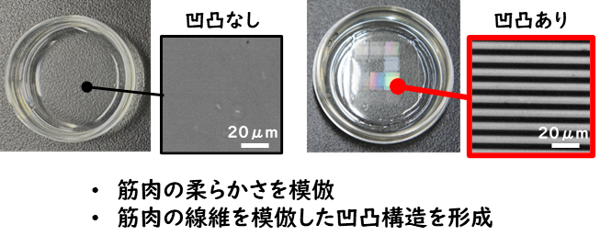
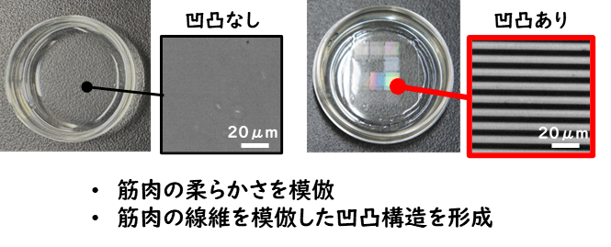
図1.身体の中の環境を模倣できるQST独自のゲル材料
<関連情報>
弾性とマイクロ溝の複合刺激が、遅筋繊維を特徴付ける整列した筋管を形成する Combined stimuli of elasticity and microgrooves form aligned myotubes that characterize slow twitch muscles
Hiroki Hamaguchi,Tomoko G. Oyama,Kotaro Oyama,Yasuko Manabe,Nobuharu L. Fujii &Mitsumasa Taguchi
Scientific Reports Published:08 August 2025
DOI:https://doi.org/10.1038/s41598-025-12744-7
Abstract
Skeletal muscles are classified into slow-twitch muscles composed primarily of type I and IIa fibers with high oxidative metabolism, and fast-twitch muscles composed of type IIx and IIb fibers with high glycolytic metabolism. Fiber-type shifts occur during development and aging; however, the stimuli that shift these types remain unclear. We analyzed the role of mechanical stimuli in myotube formation and shift to the characteristics of each fiber type using crosslinked gelatin gels with tunable elastic moduli (10–230 kPa) and microgrooves (3–50 µm). C2C12 myotubes on 10 kPa gel increased the expression of marker genes for type I and IIa fibers (MYH7 and MYH2) and oxidative metabolism (GLUT4 and myoglobin) than those on stiffer gels. Upregulation of PGC-1α on soft gel induced a shift toward slow-twitch muscle genetic characteristics. Microgrooves (3–10 µm) enhanced myoblast differentiation and myotube orientation, without affecting the gene expressions characterizing fiber types. This study demonstrated an approach to create highly oriented slow-twitch muscle models by controlling the elasticity and microgrooves.