
2025-08-20 花王株式会社
<関連情報>
- https://www.kao.com/jp/newsroom/news/release/2025/20250820-001/
- https://www.kao.com/content/dam/sites/kao/www-kao-com/jp/ja/corporate/news/2025/pdf/20250820-001-01.pdf
- https://www.nature.com/articles/s41598-025-13427-z
蚊の飛行中のクロスモーダル統合における二酸化炭素の文脈依存効果 Context-dependent effects of carbon dioxide on cross-modal integration during mosquito flight
Aya Kato-Namba,Kazumi Ohta,Takao Nakagawa & Hokto Kazama
Scientific Reports Published:20 August 2025
DOI:https://doi.org/10.1038/s41598-025-13427-z
Abstract
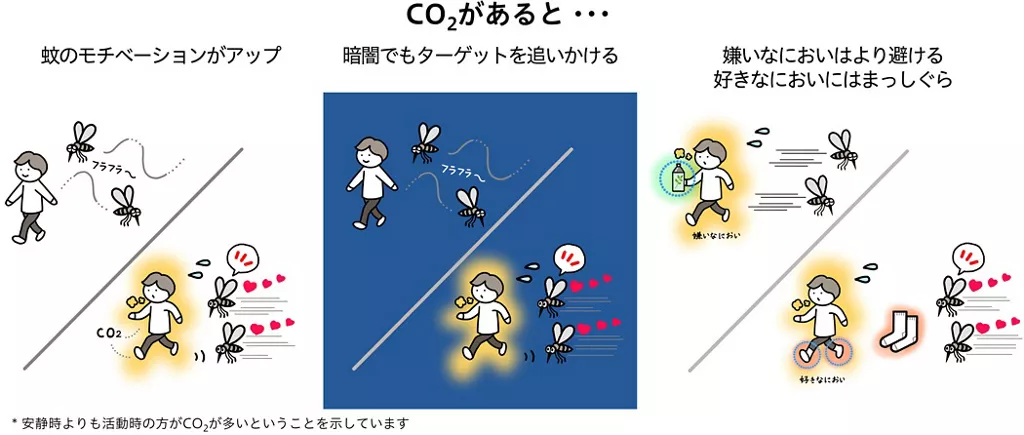
To navigate the environment and search for hosts, mosquitoes utilize multiple sensory cues including carbon dioxide (CO₂), visual, olfactory, and humidity cues. However, how mosquitoes shape their behavior by integrating these cues is poorly understood. Here we monitored the flight maneuvers of Aedes albopictus in a virtual reality environment where sensory cues were presented in open- or closed-loop. We found that CO₂ enhances optomotor responses to wide-field motion stimuli provided with various angular speeds and contrasts. Furthermore, CO₂ allowed more accurate tracking of a low contrast, visual object whose position was updated in closed-loop. We also found that olfactory preference is bidirectionally modulated by CO₂ depending on the value of odors: CO₂ enhances attraction to host odors whereas it enhances aversion to a repellent. This olfactory enhancement was further contingent on the humidity level. Together, our results highlight the context-dependent impact of CO₂ on cross-modal integration in mosquitoes.

