2025-08-22 中国科学院(CAS)
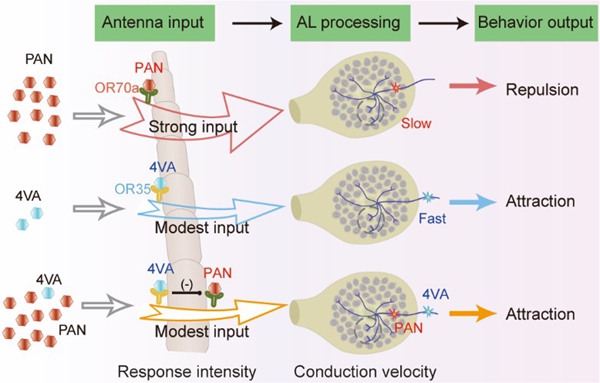
The synergistic interactions between 4VA and PAN across multiple levels facilitate locust attraction and aggregation. (Image by Prof. KANG Le’ Lab)
<関連情報>
- https://english.cas.cn/newsroom/research_news/life/202508/t20250822_1051220.shtml
- https://www.pnas.org/doi/10.1073/pnas.2501490122
イナゴは、神経感覚の優先順位付けを利用して、2つの相反する嗅覚信号を調和させながら集合する Locusts employ neuronal sensory prioritization to reconcile two conflicting olfactory signals while aggregating
Qiaoqiao Yu, Jing Yang, Jia Yu, +2 , and Xiaojiao Guo
Proceedings of the National Academy of Sciences Published:August 13, 2025
DOI:https://doi.org/10.1073/pnas.2501490122
Significance
The ability to decode complex olfactory signals and display appropriate responses is crucial for insect survival and adaptation. Gregarious locusts benefit from the integration of two pheromones, 4-vinylanisole (4VA) and phenylacetonitrile (PAN), which respectively facilitate population aggregation and predator resistance. Our findings reveal that 4VA and PAN are emitted sequentially and synergistically. Behavioral experiments involving blends of 4VA and PAN consistently elicited an attractive effect. In the antennae, 4VA inhibited the neural responses to PAN. The faster conduction velocities of 4VA compared to PAN in the antennal lobe ensured an attractive behavioral outcome. These multilayered interactions underscore the predominant role of 4VA in conspecific interactions and highlight an adaptive strategy that migratory locusts have evolved in response to complex stimuli.
Abstract
Migratory locusts (Locusta migratoria) emit two key odorants during aggregation: 4-vinylanisole (4VA), which serves as an aggregation pheromone attracting conspecifics to form swarms, and phenylacetonitrile (PAN), which acts as an aposematic signal and a precursor of a defense toxin, deterring conspecifics from cannibalism and protecting against predators. However, how locusts reconcile these two conflicting olfactory signals while aggregating is not yet understood. Our study addresses this by examining the release dynamics of the two signals, their behavioral effects, and the neural mechanisms underlying their perception. 4VA is released earlier and at lower locust densities than PAN, with PAN’s release increasing as aggregation progresses. Although PAN’s emission levels eventually exceed those of 4VA, locusts consistently exhibit a preference for the emitted blend, regardless of variations in proportions and concentrations. Notably, increasing amounts of 4VA added to PAN can counteract PAN’s repellent effects, but this is not the case when PAN is added to 4VA. Mechanistically, we found that antennal neurons responsive to 4VA suppress the activity of neurons responsive to PAN. In the antennal lobe, it is the conduction velocities of projection neurons, rather than other neural properties, that are responsible for the observed behavioral pattern, leading to an overall attractive response. Collectively, our findings imply that insects are capable of harmonizing the effects of two distinct pheromones to optimize both social cohesion and chemical defense.