2025-08-27 北海道大学
北海道大学の工藤岳特任准教授らは、高山植物ハクサンボウフウが種子食害を回避するために雄花の割合を増やす進化的戦略をとっていることを明らかにした。大雪山系で4年間観察した結果、雪解けの早い場所ではササベリガの幼虫による種子食害が多く、これに対応して両性花より雄花が多くなる傾向が確認された。両性花は昆虫の産卵対象となるため、両性花の減少は食害リスクを下げる効果がある。一方、花粉親としての成功には花数が影響し、雄花も寄与することから、雄花の増加は繁殖成功に有利と考えられる。この研究は、数百メートルという局所スケールで繁殖形質が進化する実例を示し、植物と昆虫の相互作用が形態進化に与える影響を明らかにした。
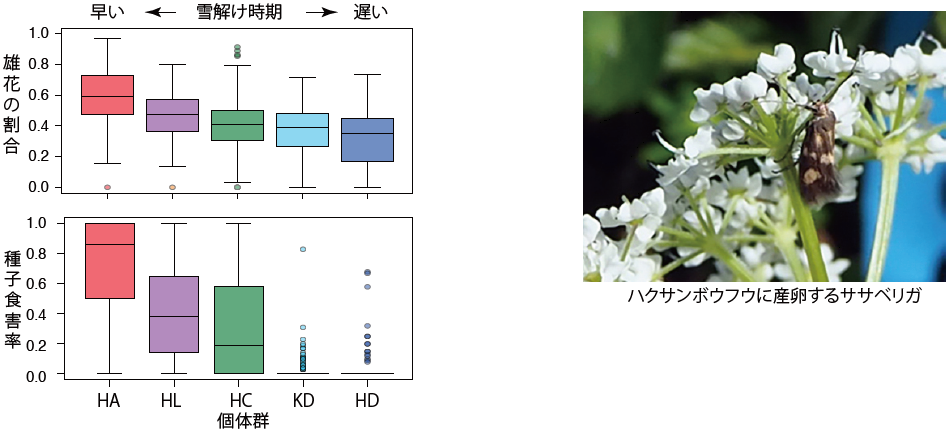
大雪山系の高山帯で観察されたハクサンボウフウ個体群の雄花の比率(上図)と、種子食害率(下図)の比較。雪解けが早い個体群では雄花の割合が高く、種子食害率が高い傾向がある。
<関連情報>
- https://www.hokudai.ac.jp/news/2025/08/post-2041.html
- https://www.hokudai.ac.jp/news/pdf/250827_pr2.pdf
- https://besjournals.onlinelibrary.wiley.com/doi/10.1111/1365-2745.70130
散布前種子食害の時間的な選択圧の違いは雄性両全性同株植物の性表現変異に作用する Phenological selection mosaic of predispersal seed predation affects gender variation in an andromonoecious plant
Gaku Kudo, Akari Shibata
Journal of Ecology Published: 29 July 2025
DOI:https://doi.org/10.1111/1365-2745.70130
Abstract
- Predispersal seed predation could influence the sexual expression of plants with sexually heteromorphic flowers. The timing of snowmelt determines the reproductive phenology of alpine plants at a given site, and it can also cause variation in the intensity of seed predation at a local level in alpine ecosystems. We investigated the associations between predation intensity and the floral sex allocation and fitness in an andromonoecious alpine herb, Peucedanum multivittatum (Apiaceae), along the natural gradient of flowering phenology in northern Japan over 4 years.
- The developing fruits of the early-flowering populations were heavily predated by moth caterpillars, whereas seed predation was negligible in the late-flowering populations because predator moths concentrated their oviposition in early summer. The moths tended to oviposit on umbels with more perfect flowers, fewer male flowers and taller flower stems.
- Plants with male-biased umbels predominated in the early-flowering populations. Selection differential and selection gradient analyses showed that greater production of perfect flowers accelerated seed predation, resulting in lower female fitness as seed producers. In contrast, male flower production contributed to a reduction in predation damage, but this was independent of male fitness as a pollen donor. Therefore, having a male-biased floral gender is advantageous in minimising seed predation and maintaining the floral display.
- The proportion of perfect flowers per umbel increased in the late-snowmelt populations, where higher production of perfect flowers led to greater fruit production due to low levels of seed predation. Along the phenological gradient, natural selection for perfect flower production shifted from negative to positive values, indicating heterogeneous local-scale selection.
- Synthesis: Our study shows that spatiotemporal variation in the intensity of seed predation acts as a selective force, promoting the local evolution of floral sex expression in andromonoecious plants.