2025-08-28 スイス連邦工科大学ローザンヌ校(EPFL)
<関連情報>
- https://actu.epfl.ch/news/mapping-the-brain-s-wiring/
- https://www.nature.com/articles/s41467-025-62030-3
- https://medibio.tiisys.com/95916/
合成軸索形態を用いた脳全体コネクトームの生成 Generating brain-wide connectome using synthetic axonal morphologies
Remy Petkantchin,Adrien Berchet,Hanchuan Peng,Henry Markram & Lida Kanari
Nature Communications Published:18 July 2025
DOI:https://doi.org/10.1038/s41467-025-62030-3
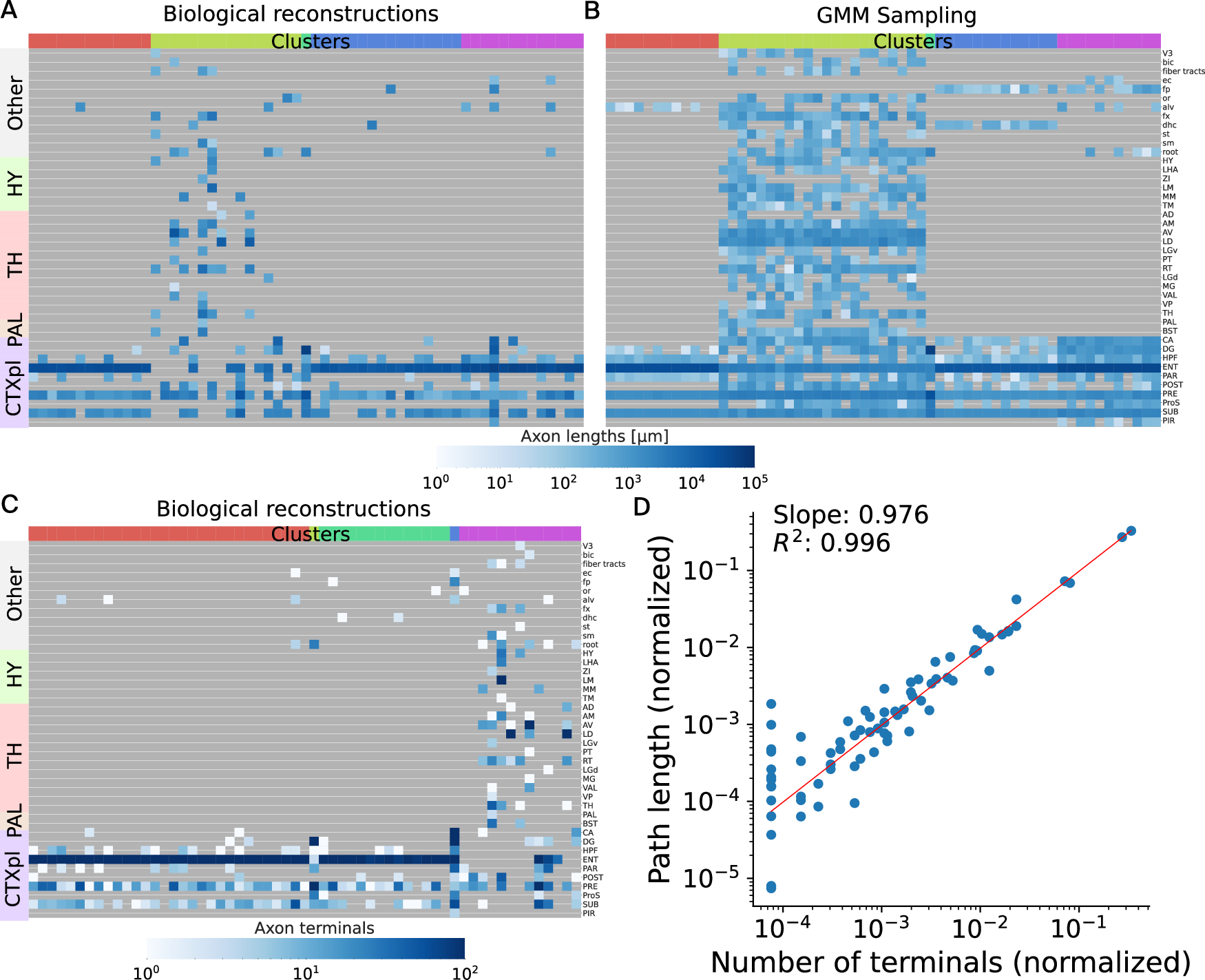
Abstract
Recent experimental advancements, including electron microscopy reconstructions, have produced detailed connectivity data for local brain regions. On the other hand, for inter-regional connectivity, large-scale imaging techniques such as MRI are best suited to provide insights. However, understanding the relationship between local and long-range connectivity is essential for studying both healthy and pathological conditions of the brain. Leveraging a dataset of whole-brain axonal reconstructions, we present a technique to predict whole-brain connectivity at single cell level for pyramidal cells in the cortex by generating detailed whole-brain axonal morphologies from sparse experimental data. The computationally generated axons accurately reproduce the local and global morphological properties of experimental reconstructions. Furthermore, the computationally synthesized axons generate large-scale inter-regional connectivity, defining the projectome and the connectome of the brain, thereby enabling the in silico experimentation of large brain regions.