2025-09-02 国立長寿医療研究センター
<関連情報>
- https://www.ncgg.go.jp/ri/report/20250902.html
- https://www.ncgg.go.jp/ri/report/documents/20250902.pdf
- https://academic.oup.com/ageing/article-abstract/54/8/afaf210/8220750
手首装着型デバイスによる虚弱度評価が中高齢者の入院・死亡を予測:英国バイオバンク研究 Frailty assessed by a wrist-worn device can predict hospitalisation and mortality in middle-aged and older adults: a UK Biobank study
Yosuke Osuka , Lloyd L Y Chan , Matthew Brodie , Yoshiro Okubo , Stephen R Lord
Age and Ageing Published:01 August 2025
DOI:https://doi.org/10.1093/ageing/afaf210
Abstract
Background
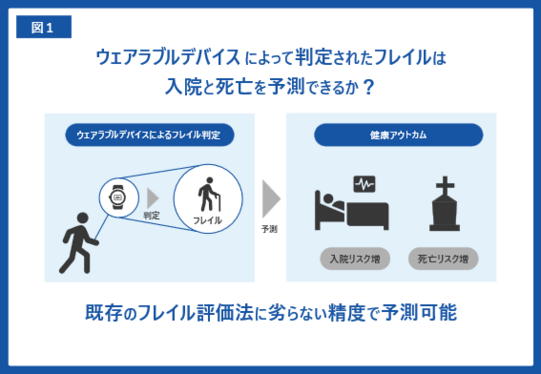
Digital gait biomarkers (DGBs) from wrist-worn devices may offer a simple, convenient method for assessing frailty; however, their clinical validity has not been sufficiently verified. This study aimed to determine whether frailty assessed using DGBs is not inferior to the Fried frailty phenotype for predicting hospitalisation and mortality.
Methods
This longitudinal study included 10 156 adults (aged 43–81 years) with complete Fried frailty phenotype and DGB data from the UK Biobank. DGBs were extracted using validated algorithms on raw data from wrist-worn accelerometers over 7 days. DGB frailty was derived from DGBs and the Fried frailty phenotype.
Results
First hospitalisations and deaths were followed for 4.4 ± 2.7 and 7.2 ± 0.7 years, respectively. In these periods, 6148 (60.5%) were hospitalised (44 277 person-years follow-up) and 270 (2.7%) died (73 312 person-years follow-up). Cox proportional hazards models, adjusting for confounders, showed that both Fried and DGB frailties were predictive of hospitalisation (hazard ratios and 95% confidence intervals [CIs]: 1.29 [1.13–1.47] versus 1.33 [1.17–1.52]) and mortality (1.63 [1.01–2.62] versus 1.77 [1.14–2.74]). The mean differences (DGB frailty–Fried frailty) and 95% CIs in Harrell’s C-index for hospitalisation and mortality were 0.000 [-0.002 to 0.001] and 0.002 [-0.004 to 0.009], respectively, with the lower limit of the 95% CIs exceeding the prespecified noninferiority margin (-0.1).
Conclusion
DGB-derived frailty predicted hospitalisation and mortality and was not inferior to the Fried frailty phenotype. These findings support the clinical validity and potential utility of wearable devices in the assessment of frailty in clinical practice.