2025-09-10 ロードアイランド大学(URI)
<関連情報>
- https://www.uri.edu/news/2025/09/uri-study-links-microplastic-exposure-to-alzheimers-disease-in-mice/
- https://iopscience.iop.org/article/10.1088/2515-7620/adf8ae
ポリスチレン微小プラスチックへの短期曝露は、アポリポプロテインE(APOE)遺伝子型および性別に依存した認知機能・免疫・代謝マーカーを変化させる Short-term exposure to polystyrene microplastics alters cognition, immune, and metabolic markers in an apolipoprotein E (APOE) genotype and sex-dependent manner
Lauren Gaspar, Sydney Bartman, Hannah Tobias-Wallingford, Giuseppe Coppotelli and Jaime M Ross
Environmental Research Communications Published: 20 August 2025
DOI:10.1088/2515-7620/adf8ae
Abstract
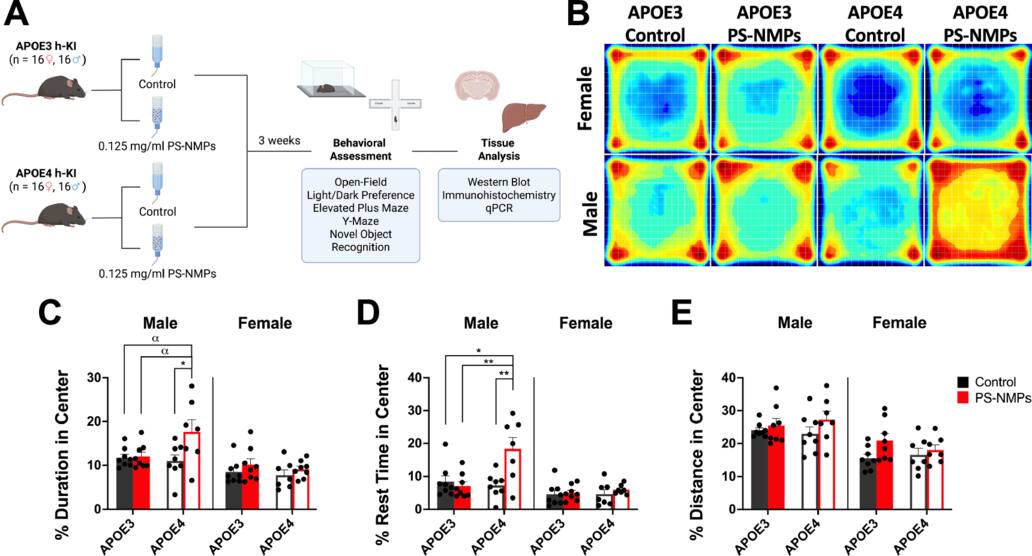
Alzheimer’s disease (AD) is one of the most prevalent neurodegenerative disorders and one of the leading causes of death in individuals over the age of 65. Most cases of AD develop sporadically, however, there are several risk factors that have been identified which significantly increases an individual’s risk for developing AD. The most prominent of these is Apolipoprotein E4 (APOE4), which can potentially result in an up to 10-fold greater risk of developing AD. The presence of APOE4 alone, however, cannot be solely responsible for AD as the disease may occur even in the absence of APOE4. Therefore, there must be other contributing factors such as exposure to environmental toxins including heavy metals and pesticides, which have independently been shown to contribute to AD. Nano- and microplastics (NMPs) are plastic particles less than 1 μm and 5 mm in size, respectively, and have only recently been identified as a major environmental pollutant with serious health concerns. Given the adverse health effects that are increasingly being associated with NMPs exposure, we sought to understand how the combination of APOE4 and NMPs exposure may work synergistically to promote cognitive dysfunction and alter key regulatory pathways to impact overall health. Following a short-term (3 week) exposure to pristine spherical fluorescently-labeled 0.1 and 2 μm polystyrene (PS) NMPs, we found significant sex-dependent alterations in locomotor and recognition memory in APOE4 mice, but not in APOE3 controls. We additionally found that exposure to PS-NMPs resulted in sex and genotype specific alterations in astrocytic and microglial markers in the brain, and in CYP1A1, a major metabolizer of environmental polycyclic aromatic hydrocarbons, in the liver. These results suggest PS-NMPs may interact with the APOE4 allele to promote cognitive dysfunction and alter immune and metabolic pathways which may contribute to disease-like states.