
2025-09-16 国立成育医療研究センター
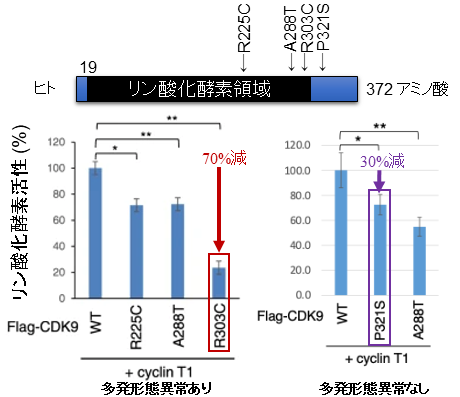
【図1:CDK9バリアントのリン酸化能と病態の対応】
<関連情報>
- https://www.ncchd.go.jp/press/2025/0916.html
- https://www.ncchd.go.jp/press/assets/0916.pdf
- https://www.nature.com/articles/s10038-025-01395-1
CHARGE様奇形症候群を伴わない網膜ジストロフィーに関連する新規両対立遺伝子型CDK9変異 Novel biallelic CDK9 variants are associated with retinal dystrophy without CHARGE-like malformation syndrome
Sachiko Nishina,Kaoruko Torii,Shizuka Ishitani,Tomoyo Yoshida,Maki Fukami,Kenji Kurosawa,Kenjiro Kosaki,Hirotomo Saitsu,Tohru Ishitani & Yoshihiro Hotta
Journal of Human Genetics Published:16 September 2025
DOI:https://doi.org/10.1038/s10038-025-01395-1
Abstract
Cyclin-dependent kinase 9 (CDK9) phosphorylates the C-terminal domain of RNA polymerase II (RNAPII) to regulate transcription. Previously, we reported that an 8-year-old boy with the biallelic CDK9 variants p.A288T and p.R303C exhibited a CHARGE-like malformation syndrome in which retinal dystrophy was a distinguishing feature. This dystrophy was caused by the decreased CDK9 kinase activity associated with these variant alleles [wild-type (WT) > A288T > R303C]. In this study, we describe a female patient who also bears biallelic CDK9 variants but displays retinal dystrophy without a CHARGE-like malformation syndrome. Trio-based whole-exome sequencing identified a new variant CDK9 allele, p.P321S, that occurred de novo in the patient. As a result, this female patient displayed compound heterozygous variants composed of the p.A288T CDK9 variant of maternal origin plus the novel p.P321S variant. With respect to reduced kinase activity, the new variant could be ranked as WT > P321S > A288T. Thus, our study raises a possibility that retinal dystrophy can arise with or without a CHARGE-like malformation syndrome depending on the level of kinase activity associated with the combination of variant CDK9 alleles present.
CHARGE症候群を模倣する網膜ジストロフィーを伴う新規多発奇形症候群の原因としての両対立遺伝子型CDK9変異 Biallelic CDK9 variants as a cause of a new multiple-malformation syndrome with retinal dystrophy mimicking the CHARGE syndrome
Sachiko Nishina,Katsuhiro Hosono,Shizuka Ishitani,Kenjiro Kosaki,Tadashi Yokoi,Tomoyo Yoshida,Kaoru Tomita,Maki Fukami,Hirotomo Saitsu,Tsutomu Ogata,Tohru Ishitani,Yoshihiro Hotta & Noriyuki Azuma
Journal of Human Genetics Published:27 February 2021
DOI:https://doi.org/10.1038/s10038-021-00909-x
Abstract
CDK9 has been considered a candidate gene involved in the CHARGE-like syndrome in a pair of cousins. We report an 8-year-old boy with a strikingly similar phenotype including facial asymmetry, microtia with preauricular tags and bilateral hearing loss, cleft lip and palate, cardiac dysrhythmia, and undescended testes. Joint contracture, no finger flexion creases, and large halluces were the same as those of a previously reported patient with homozygous CDK9 variants. The ocular phenotype included blepharophimosis, lacrimal duct obstruction, eyelid dermoids, Duane syndrome-like abduction deficit, and congenital cataracts. Optical coherence tomography and electroretinography evaluations revealed severe retinal dystrophy had developed at an early age. Trio-based whole-exome sequencing identified compound heterozygous variants in CDK9 [p.(A288T) of maternal origin and p.(R303C) of paternal origin] in the patient. Variants’ kinase activities were reduced compared with wild type. We concluded that CDK9 biallelic variants cause a CHARGE-like malformation syndrome with retinal dystrophy as a distinguishing feature.

