2025-09-18 基礎生物学研究所,生命創成探究センター,総合研究大学院大学
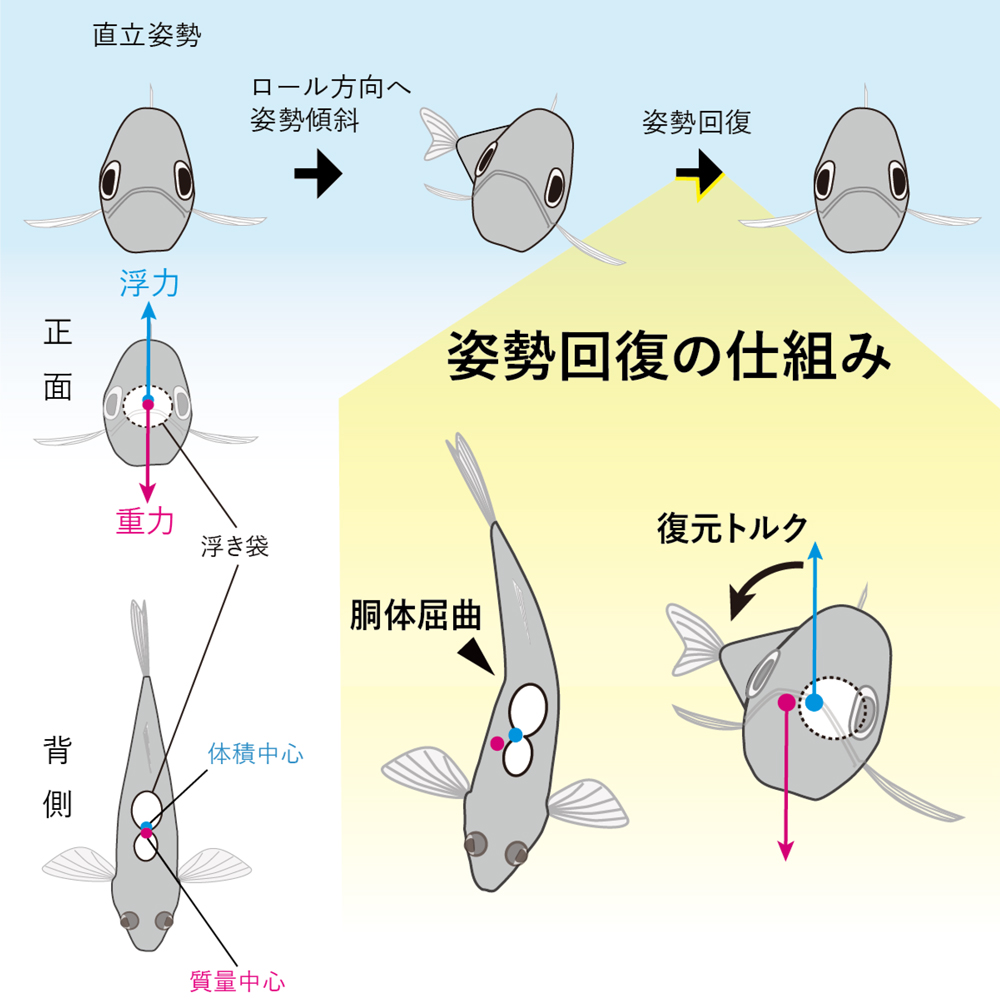
図1.研究の概要
ゼブラフィッシュ成魚は、左右(ロール)方向に体が傾くと上側になる体側へ体を曲げる。この際、浮き袋(空気で満たされ密度が極めて低い)の体全体に対する相対位置が移動し、重力と浮力の作用軸がずれることで姿勢復元トルクが発生して姿勢回復する。
<関連情報>
- https://www.nibb.ac.jp/press/2025/09/18.html
- https://www.cell.com/iscience/fulltext/S2589-0042(25)01677-3
成体ゼブラフィッシュにおける体幹屈曲による静的ロール姿勢制御の生物力学 Biomechanics of static roll posture control by body flexion in adult zebrafish
Ryota Nagaoka ∙ Taisei Katayama ∙ Shin-ichi Higashijima ∙ Masashi Tanimoto
iScience Published:August 21, 2025
DOI:https://doi.org/10.1016/j.isci.2025.113416
Highlights
- Adult zebrafish flexed their body to the ear-up side when roll-tilted
- Biomechanical model linked body flexion to restoring torque generation
- Deflating the swim bladder impaired postural recovery, consistent with the model
- Restoring torque generation was proved in body-flexed, fixed fish specimens
Summary
Posture control is crucial for animals. Static posture control in fish remains poorly explored. Recent studies have shown that larval zebrafish perform body flexion during slight roll tilts: the body flexion displaces a gas-filled swim bladder, generating counter-rotation torque for postural recovery through the misalignment of gravity and buoyancy forces. Swim bladder deflation impairs this postural recovery, suggesting its critical role. This static posture control strategy may be utilized by many fish species. However, adult fish differ from larvae in morphology and behavior, raising questions about the generality of this mechanism. Our behavioral analysis showed that adult zebrafish also flexed their body during roll tilts, with flexion persisting until recovery to an upright posture. Similarly to larvae, swim bladder deflation impaired postural recovery. These results demonstrate that adult fish employ static roll posture control through body flexion and suggest the generality of this mechanism in fish species.