2025-09-24 慶應義塾大学医学部,理化学研究所
Web要約 の発言:
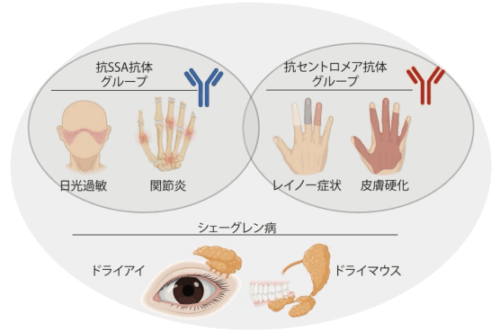
【図 1:シェーグレン病の自己抗体別の臨床所見】
<関連情報>
- https://www.keio.ac.jp/ja/press-releases/2025/9/24/28-169318/
- https://www.keio.ac.jp/ja/press-releases/files/2025/9/24/250924-1.pdf
- https://www.nature.com/articles/s41467-025-63935-9
シェーグレン病における自己抗体別の病態解明:シングルセル・空間解析が明らかにした共通点と相違点 Comparative single-cell and spatial profiling of anti-SSA-positive and anti-centromere-positive Sjögren’s disease reveals common and distinct immune activation and fibroblast-mediated inflammation
Jun Inamo,Masaru Takeshita,Katsuya Suzuki,Kazuyuki Tsunoda,Satoshi Usuda,Junko Kuramoto,Jonathan Moody,Chung-Chau Hon,Yoshinari Ando,Takashi Sasaki,Kazutoshi Yoshitake,Susumu Mitsuyama,Shuichi Asakawa,Yae Kanai,Tsutomu Takeuchi & Yuko Kaneko
Nature Communicatkions Published:22 September 2025
DOI:https://doi.org/10.1038/s41467-025-63935-9
Abstract
Sjögren’s disease (SjD) is an autoimmune disease that causes salivary gland dysfunction due to immune-mediated destruction. While autoantibodies such as anti-SSA and anti-centromere (CENT) are associated with distinct clinical manifestations, the molecular features remain to be elucidated. In this study, we apply multi-modal single-cell technologies: single-cell RNA sequencing, T cell and B cell receptor sequencing and spatial transcriptomics to salivary gland lesions, aiming to elucidate common and unique cellular and transcriptional signatures linked to different autoantibody profiles. Our analysis demonstrates that GZMB+GNLY+ CD8+ T cells are the main expanded subset across different autoantibody statuses, highlighting their central role in SjD pathogenesis, while the enrichment of memory B cells is more prominent in anti-CENT-positive patients. Cytokine signaling also differs by autoantibody profile, with an activated interferon signature in anti-SSA-positive patients, whereas TGFβ signaling is enhanced in anti-CENT-positive patients. Furthermore, spatial profiling reveals THY1+ fibroblasts, expressing complement genes and chemokines, as key hubs orchestrating inflammation within the salivary glands. These findings deepen our understanding of the pathogenesis of SjD, and may inform the development of targeted and personalized therapeutic strategies.