2025-08-04 ラトガース大学
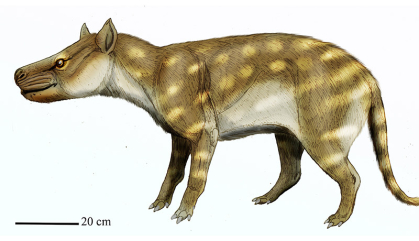
Fossil studies of the extinct predator Dissacus praenuntius offer clues as to how ancient animals responded to environmental changes. The ancient omnivore was about the size of a jackal or a coyote.
ДиБгд, CC BY 4.0 , via Wikimedia Commons
<関連情報>
- https://www.rutgers.edu/news/ancient-predators-shift-diet-offers-clues-surviving-climate-change
- https://www.sciencedirect.com/science/article/abs/pii/S0031018225003748
暁新世-始新世温暖極大期におけるメソニクス科魚類Dissacus praenuntiusの食性変化 Dietary change across the Paleocene-Eocene Thermal Maximum in the mesonychid Dissacus praenuntius
Andrew Schwartz, Larisa R.G. DeSantis, Rob S. Scott
Palaeogeography, Palaeoclimatology, Palaeoecology Available onlin:e 13 June 2025
DOI:https://doi.org/10.1016/j.palaeo.2025.113089
Highlights
- Dental microwear shows Dissacus praenuntius diet is consistent with osteophagy.
- D. praenuntius closely resembled hyaenids in dental microwear and ecology.
- Dental microwear differs significantly across the Paleocene-Eocene Thermal Maximum.
- Resource limitation caused ecological modification during intense climate change.
Abstract
The effect of climate change and ecological disruption on species diets is critical for understanding the evolution of mammalian adaptations and potential risks from the current climate crisis. Here, we use dental microwear texture analysis (DMTA), a likely correlate of the mechanical properties of masticated food, to infer changes in diet within the mesonychid Dissacus praenuntius across the Paleocene-Eocene Thermal Maximum (PETM), a period of geological rapid warming and aridification ∼56 million years ago. Our results clarify previous reconstructions of this species as a small vertebrate mesocarnivore by emphasizing a durophagous dietary component. By comparing dental microwear across the PETM, we conclude that Dissacus praenuntius consumed less flesh and more bone during and after the PETM in comparison to before the event. Coupled with body mass reduction, dietary change during the PETM supports reduced primary and secondary productivity, rather than increased temperatures directly as a major probable cause of body mass reduction. We show that climate and ecological changes during the PETM caused dietary shifts in a species of flesh-eating mesonychid. These results reveal the ecology of the first large mammal predators as well as how mammalian diet may respond to modern climatic and habitat disruption.