2025-10-10 理化学研究所
Web要約 の発言:
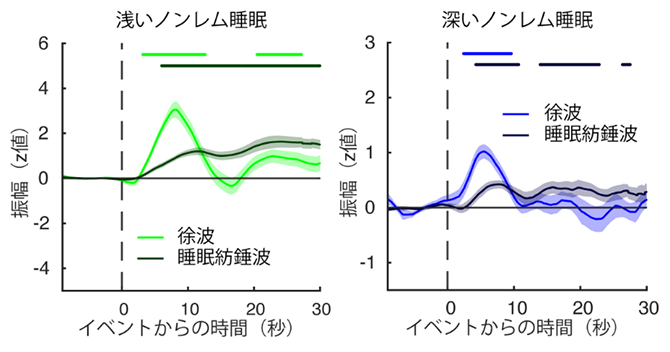
脳波活動に対応して生じる脳脊髄液(CSF)信号の変化
<関連情報>
- https://www.riken.jp/press/2025/20251010_2/index.html
- https://www.pnas.org/doi/10.1073/pnas.2509626122
人間の深い睡眠は、自発的な脳の振動や神経活動に関連する脳脊髄液の動態を促進する Human deep sleep facilitates cerebrospinal fluid dynamics linked to spontaneous brain oscillations and neural events
Makoto Uji, Xuemei Li, An Saotome, +5 , and Masako Tamaki
Proceedings of the National Academy of Sciences Published:October 7, 2025
DOI:https://doi.org/10.1073/pnas.2509626122
Significance
Sleep is indispensable to our life, but its functions remain a significant mystery in the field of neuroscience. One of the most enigmatic issues in sleep is whether and how sleep regulates the cerebrospinal fluid (CSF). The present study demonstrates deep sleep–specific CSF dynamics time-locked to sleep brain oscillations and neural events, such as slow waves and sleep spindles during slow-wave sleep and rapid eye movements and sawtooth waves during rapid-eye movement (REM) sleep, in healthy young human participants. This study suggests a fundamental property of deep sleep for the maintenance of brain functions and offers a clue as to why deep sleep matters for the human brain.
Abstract
How sleep maintains our healthy brain function has remained one of the biggest mysteries in neuroscience, medical settings, and daily lives. While cerebrospinal fluid (CSF) during sleep has been implicated in metabolic waste reduction in animals, how CSF dynamics are driven in the healthy human brain during deep sleep remains elusive. A myriad of research has shown that crucial cognitive processing manifests in slow-wave and rapid-eye movement (REM) sleep, suggesting that a key to maintaining brain functions lies in deep sleep. By leveraging a simultaneous sparse-functional MRI and polysomnography method, we demonstrate that deep sleep–specific CSF dynamics are associated with spontaneous brain oscillations in healthy young human participants. Slow waves and sleep spindles during slow-wave sleep are tightly linked to short-cycle, frequent, and moderate CSF fluctuations. In contrast, slow waves during light sleep and arousals produce slow, infrequent, and steep CSF signal changes. Rapid eye movements and sawtooth waves during REM sleep are also linked to CSF signal changes. Furthermore, CSF signals are significantly faster in frequency during deep than light sleep. These brain oscillations during light and deep sleep recruit essentially different brain networks, with deep sleep involving memory and homeostatic circuits. Thus, human deep sleep has a unique way of facilitating CSF dynamics that are distinctive from arousal mechanisms.