2025-10-15 東京科学大学
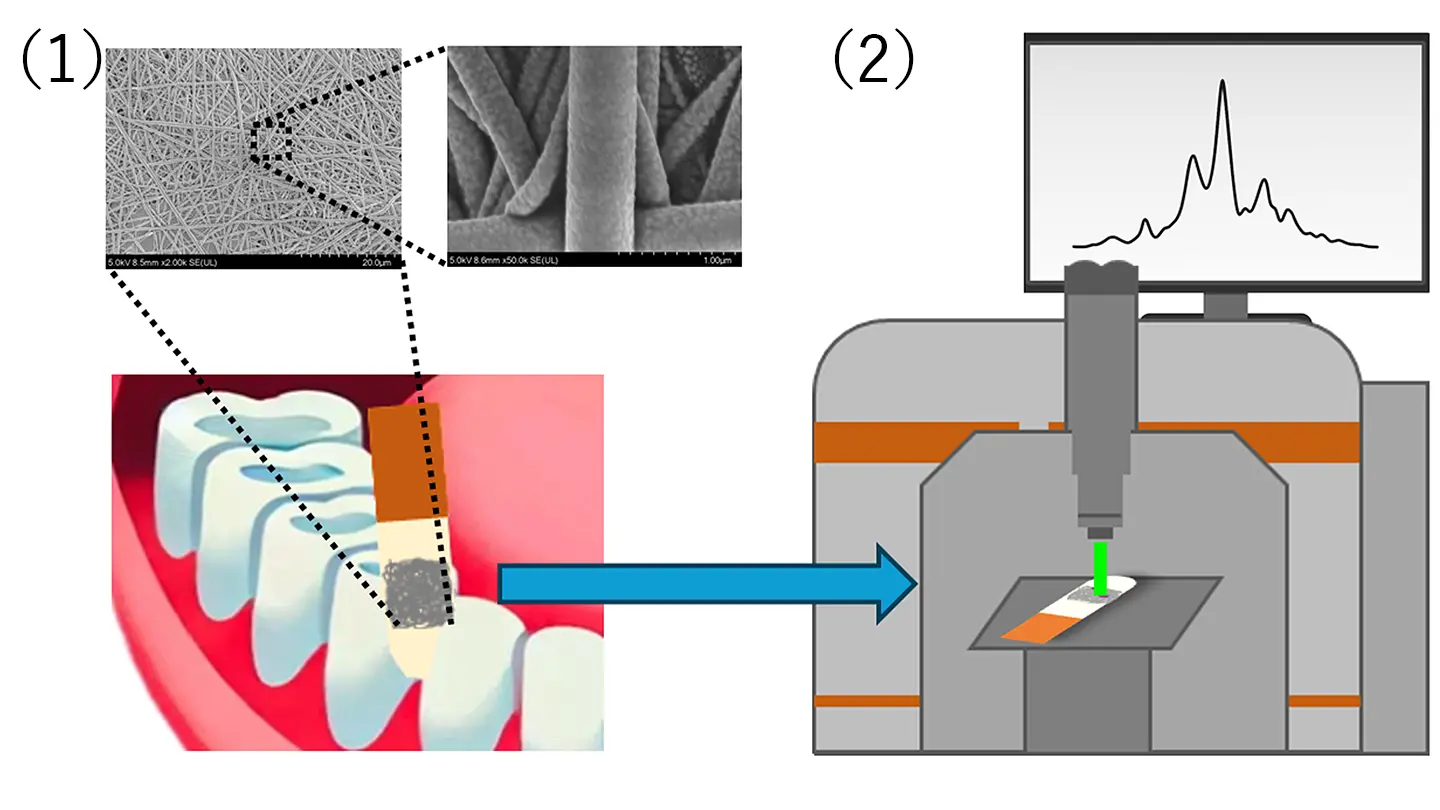
図1. 歯周病の状態を簡便かつ安価に早期検出する手法
(1)銀ナノメッシュを貼付したペリオペーパーを歯周ポケットに差し込む
(2)表面増強ラマン分光測定で歯周病関連バイオマーカーを高感度検出
<関連情報>
銀ナノメッシュコーティングされたペリオペーパーを用いた表面増強ラマン分光法による高感度、低コスト、歯周病の早期検出 Sensitive, Low-Cost, Early Detection of Periodontal Disease Using Surface-Enhanced Raman Spectroscopy with Easy-to-Use Silver Nanomesh-Coated Periopaper
Yumeng Jiang,Ryosuke Yanagida,Mitsuko Saito,Yoko Wakasugi,Yujin Ohsugi,Jun-Yu Dong,Sayaka Katagiri,Koichiro Matsuo,Shin Konno,Yasutaka Kitahama,Haruka Tohara,and Keisuke Goda
Analytical Chemistry Published: September 24, 2025
DOI:https://doi.org/10.1021/acs.analchem.5c03876
Abstract
Periodontal disease is a widespread inflammatory condition, with growing recognition as a contributor to systemic diseases, including cardiovascular, metabolic, and neurodegenerative disorders. Early diagnosis is critical for effective intervention, yet current methods, such as periodontal probing, X-ray imaging, PCR testing, and salivary biomarker testing, are limited by invasiveness, operator dependence, cost, or low sensitivity. Here, we present a sensitive, low-cost, and user-friendly method for early periodontal disease detection using surface-enhanced Raman spectroscopy with a silver-nanomesh-coated periopaper strip. This flexible substrate enables the in situ analysis of gingival crevicular fluid biomarkers without the need for sample preparation. The platform addresses key limitations of existing methods by providing high sensitivity for early-stage detection, a broad biochemical profile, repeatable measurements for longitudinal monitoring, and greater environmental stability than saliva-based assays. In a clinical study involving 43 teeth from 34 participants, our system reliably detected disease severity, including cases with probing pocket depths of up to 10 mm. Given its simplicity, affordability, and robustness, this approach is well-suited for use in primary care or resource-limited settings. Moreover, its extensibility to other biomarker targets highlights its potential for broader application in the diagnosis of both oral and systemic diseases.