2025-10-15 東京科学大学
Web要約 の発言:
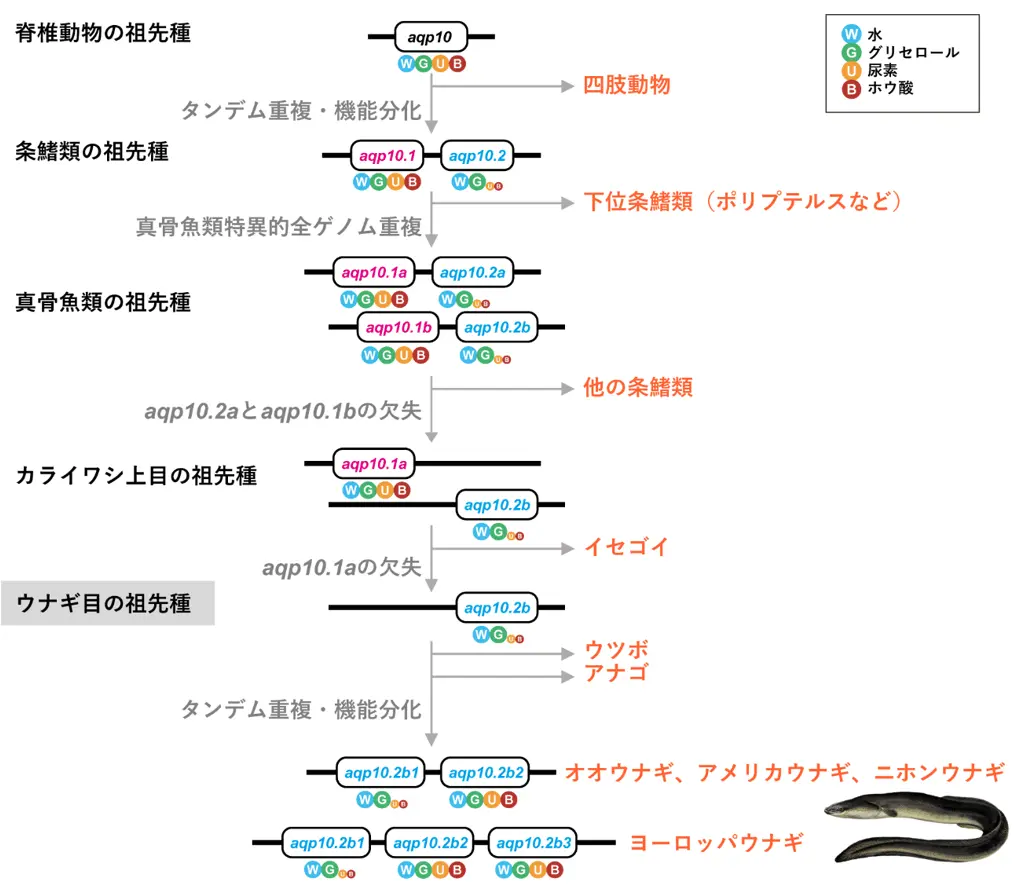 図1.ウナギ目におけるAqp10遺伝子(aqp10.1)の進化。ニホンウナギのイラストはDOI: 10.7875/togopic.2024.206より引用。© 2016 DBCLS TogoTV, CC-BY-4.0
<関連情報>
- https://www.isct.ac.jp/ja/news/ckh1gck16aq9
- https://academic.oup.com/gbe/article/17/10/evaf169/8251923
ウナギ科魚類における広範な溶質選択性を示すAqp10パラログの喪失と獲得 Loss and Gain of Aqp10 Paralogs With Broad Solute Selectivity in Anguillid Eels
Ayumi Nagashima, Shinichiro Hidaka, Chihiro Ota, Daisuke Yamanaka, Koichi Ito, Tsutomu Nakada, Tadaomi Furuta, Akira Kato
Genome Biology and Evolution Published:12 September 2025
DOI:https://doi.org/10.1093/gbe/evaf169
Abstract
Aquaporin (Aqp) 10 is a member of the aquaglyceriporin family, which transports small, uncharged solutes in addition to water. Although the solute selectivity of aquaglyceroporins varies, the mechanism of solute selectivity has not yet been fully elucidated. The common ancestor of ray-finned fish possessed two paralogous genes for aquaporin 10, aqp10.1 and aqp10.2, which produce Aqps with different solute selectivities. Most teleosts possess one or more ohnologs derived from aqp10.1 and aqp10.2; however, the common ancestor of Anguilliformes species lost all aqp10.1-derived ohnologs. Anguilliformes species, except Anguilla species, have one aqp10.2b, but recent tandem duplications in the European eel have generated three aqp10.2b paralogs (aqp10.2b1–aqp10.2b3), whose activities remain ambiguous. In this study, we found that the four sites forming the aromatic/arginine (ar/R) selectivity filter in European eel Aqp10.2b1 were identical to those in Aqp10.2b of other species. However, the Y residue at position 3 was replaced with G in the ar/R selectivity filter of Aqp10.2b2 and b3. When expressed in Xenopus oocytes, Aqp10.2b2 and b3 showed higher permeability to urea and boric acid than Aqp10.2b1, indicating that Aqp10.2b2 and b3 acquired broad solute selectivity similar to that of Aqp10.1, which was lost in the ancestral Anguilliformes species. Urea and boric acid permeabilities of Aqp10.2b1 increased when the Y residue at position 3 of the ar/R selectivity filter was replaced with G. Overall, our results outline the history of the loss and gain of Aqp10 paralogs with broad solute selectivity in anguillid eels.