2025-11-11 東京科学大学
Web要約 の発言:
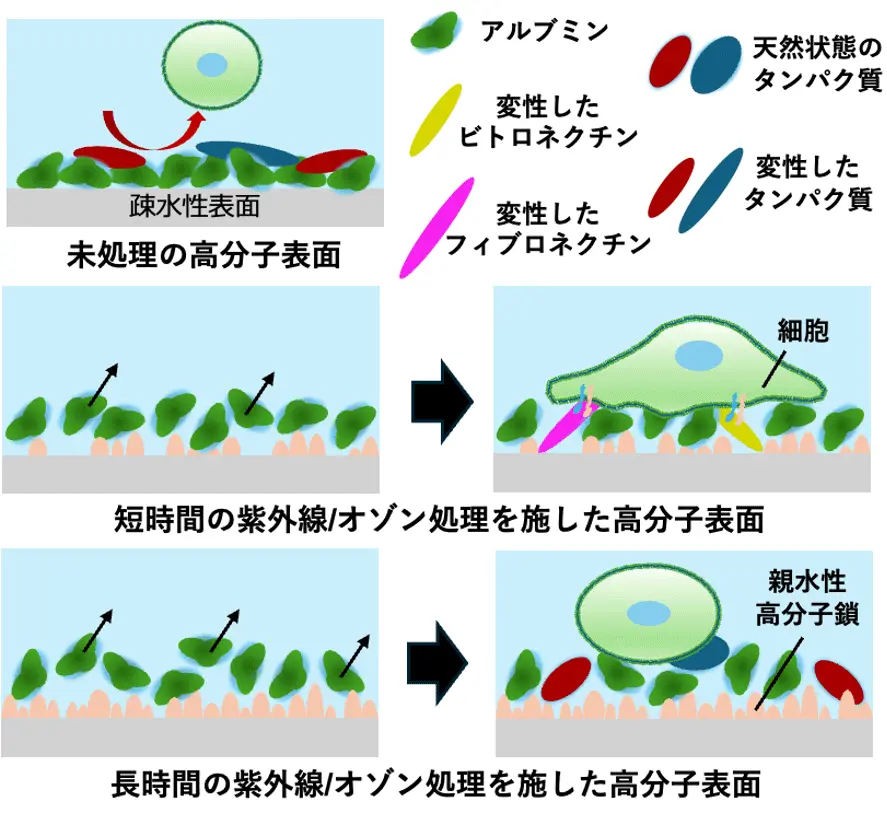
図1.本研究手法で明らかとなった紫外線/オゾン処理による界面の変化と細胞接着への影響
<関連情報>
細胞接着を強化するためのポリマー表面のUV/オゾン処理:そのメカニズムと最適化のガイドライン UV/Ozone Treatment of Polymer Surfaces to Enhance Cell Adhesion: The Mechanism and Guidelines for Optimization
Riko Kaizu,Seiichiro Takahashi,Kenichi Hirose,Kenji Hatakeyama,Glenn Villena Latag,Ayano Nomura,Hiroyuki Tahara,and Tomohiro Hayashi
Langmuir Published: October 22, 2025
DOI:https://doi.org/10.1021/acs.langmuir.5c03398
Abstract
Despite the widespread use of UV/ozone (UVO) treatments to improve cell adhesion and proliferation on polymer substrates, a complete understanding of the mechanism has not been achieved. This study investigates the effect of UVO treatment on the physicochemical properties of polymer surfaces (polystyrene and cyclo-olefin polymer) and protein adsorption, focusing on its impact on cell adhesion and the underlying mechanisms. UVO treatment with short time (1 or 2 min) significantly enhances cell adhesion, whereas treatment longer than 10 min results in poor adhesion. The treatment introduces oxygen-containing functional groups and increases wettability; however, the results indicate that wettability alone is not a determining factor for cell adhesion. Atomic force microscopy (AFM) imaging revealed nanoscale structural changes on treated surfaces, while enzyme-linked immunosorbent assay (ELISA) and quartz crystal microbalance with energy dissipation (QCM-D) analysis demonstrated that protein adsorption and denaturation are influenced by treatment duration. Additionally, the study observed the Vroman effect, showing that protein exchange on UVO-treated surfaces changes the composition of the protein layer. It was further suggested that on surfaces with short UVO treatment, fibronectin (FN) and vitronectin (VN) trapped on remaining hydrophobic areas serve as cell recognition sites, thus promoting adhesion. Overall, these findings reveal that UVO treatment duration influences protein adsorption on polymer surfaces and improves cell attachment, offering valuable insights for designing better tissue culture surfaces and enhancing material-cell interactions in biomedical contexts.